


After months of negotiations, the European Commission finally released, as part of a broader health package, the Safe Hearts Plan in December. This is the first-ever strategy at EU level dedicated to cardiovascular diseases (CVDs), which remain the leading cause of death in the European Union.
As we already argued in our previous opinion piece, the urgency and pressure on the EU agenda were extremely high. The social and economic costs of cardiovascular diseases are unsustainable: every year, over 1.62 million people die from heart disease in the EU, while the overall cost to the European economy has reached €282 billion annually, including healthcare expenditure and productivity losses.
To put this into perspective, the COVID-19 pandemic, one of the most significant public health crises in recent history, caused approximately 1.2 million deaths across the EU between 2020 and 2022. This figure is lower than the number of deaths caused by cardiovascular diseases in one year. This comparison alone explains why CVDs have rightly been identified as Europe’s biggest health and sanitary challenge.
This reality has been acknowledged by the new European Commission, which decided to move quickly towards the adoption of a dedicated EU Cardiovascular Health Plan.
The Conception of the Plan and the Main Challenges Ahead
Inspired by the success of Europe’s Beating Cancer Plan, the European Commission launched a feedback and consultation process during summer 2024 to shape its new cardiovascular strategy. The response was clear: more than 670 stakeholders from across the EU participated, including NGOs, patient organisations, hospitals, universities, research centres, and private companies.
The message was strong: the need for an effective, coordinated, and comprehensive EU strategy on cardiovascular diseases could not be ignored any longer.
From the outset, the main challenges were evident. While cardiovascular mortality is decreasing in some Member States, progress remains uneven and insufficient. Deaths must be reduced further, especially at a time when the EU is facing an ageing population, shortages of healthcare resources and personnel, and a renewed political focus on economic competitiveness and productivity.
As underlined by Romana Jerković (S&D, Croatia), the European Parliament’s leading MEP on the cardiovascular strategy, preventing CVDs is also a competitiveness priority for the EU. Healthier populations live longer, remain active for longer, and reduce losses linked to productivity, healthcare expenditure, long-term treatment costs, and social support.
The challenges ahead are therefore urgent and complex:
- scaling up prevention to reduce hospitalisation costs and long-term care;
- addressing gender inequalities as well as regional and national disparities;
- ensuring a patient-centred approach to prevention and care;
- improving data availability and quality to support research and innovation; and
- adopting a holistic approach to cardiovascular diseases, which often coexist with other chronic conditions.
How the Safe Hearts Plan Is Structured
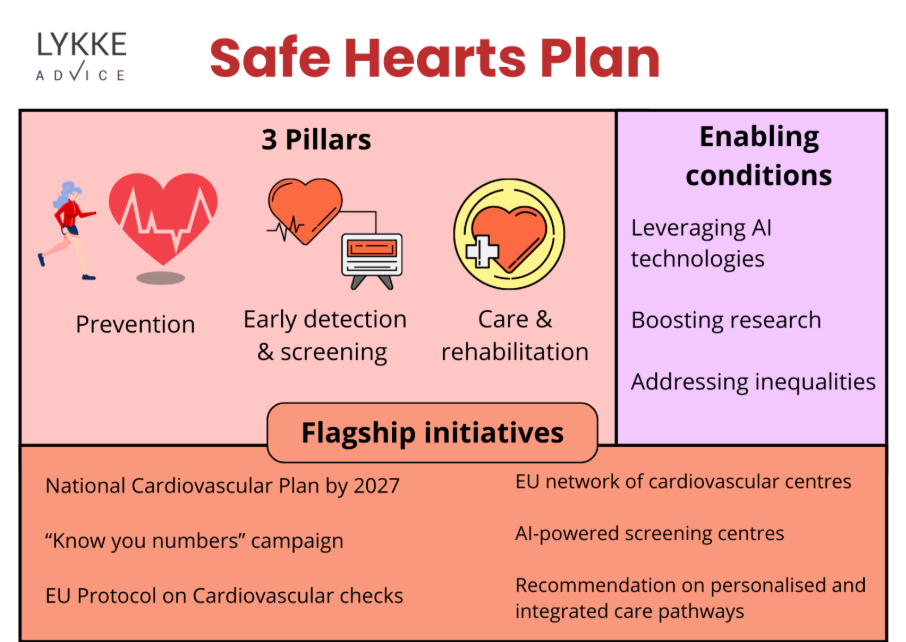
The Safe Hearts Plan follows a simple but coherent structure. It identifies three key pillars across the entire cardiovascular pathway:
- Prevention and risk reduction
- Early detection and screening
- Treatment, rehabilitation, and long-term care
To support the achievement of these goals, the Commission has also identified three cross-cutting priorities:
- Leveraging the opportunities offered by digital and AI technologies
- Boosting research and closing innovation gaps
- Addressing inequalities and ensuring a patient-centred approach throughout the entire pathway
Prevention: The Foundation of the Strategy
It is widely accepted that prevention is the most effective way to avoid the onset of disease, save lives, and reduce treatment costs. Yet, when it comes to cardiovascular diseases, prevention has long been underdeveloped, despite the fact that CVDs are often more preventable and treatable than other major diseases.
This failure to prioritise prevention has led directly to the situation Europe faces today. To reverse this trend, the Commission stresses that no risk factor should be left behind, making a holistic approach the only viable option.
As acknowledged by Health Commissioner Olivér Várhelyi, obesity and type 2 diabetes form a dangerous “triangular relationship” with cardiovascular diseases. Obesity drives metabolic dysfunction and insulin resistance, diabetes independently damages heart structures, and together they significantly increase the risk of heart failure, stroke, and coronary artery disease.
One of the reasons prevention has been insufficient is the lack of national cardiovascular plans in many Member States. While the EU can define a general framework and provide guidance, healthcare remains a Member State competence, and in some countries even a regional competence, resulting in fragmented approaches.
This is why the first flagship initiative of the Safe Hearts Plan focuses on lifelong, personalised prevention, encouraging Member States to develop, implement, or update integrated national cardiovascular health plans by 2027.
At present, only 13 Member States — Croatia, Czechia, Estonia, Finland, France, Latvia, Luxembourg, the Netherlands, Poland, Portugal, Romania, Spain, and Sweden — have adopted such plans. The Safe Hearts Plan therefore aims to encourage lagging countries to act, while supporting those that already have plans in updating and fully implementing them.
The Plan also proposes concrete actions addressing the commercial determinants of cardiovascular disease, including the promotion of healthy lifestyles and diets, limiting ultra-processed food consumption, and reducing tobacco and alcohol use. These actions include improved food labelling, consumer awareness campaigns, and the upcoming revision of tobacco taxation legislation, currently foreseen for 2027, in line with the EU objective of reducing tobacco use among adults to 5% by 2040.
Particular concern is raised regarding younger generations increasingly using vaping and heated tobacco products, which are often perceived as entry gateways to nicotine addiction and represent a serious long-term cardiovascular risk.
Alcohol consumption is also highlighted as a major risk factor. The Plan suggests increasing levies, taxes, and duties on alcoholic beverages, following examples from Member States such as Latvia, where retail alcohol sales have been restricted by time since August 2025. This demonstrates how concrete regulatory measures can effectively reduce consumption.
The Plan further recognises climate change and environmental factors as emerging cardiovascular risks. Extreme heat and air pollution have a significant negative impact on cardiovascular health, prompting the Commission to encourage Member States to integrate these considerations into national health and climate strategies.
At the same time, the European Parliament has raised criticism regarding the Plan’s limited focus on economic and social determinants of health. In its forthcoming own-initiative report, to be tabled by MEP Romana Jerković, Parliament regrets that these determinants did not receive sufficient attention in the Commission’s proposal.
Early Detection and Screening
Early detection and screening constitute the second core pillar of the Safe Hearts Plan. The Commission strongly acknowledges their importance as public health tools, particularly given that nearly 80% of cardiovascular deaths are preventable.
One of the most alarming findings is that over 27% of patients suffering a heart attack have no known risk factors prior to the event. This highlights the limits of traditional risk assessment and the urgent need for broader screening strategies.
In response, the Commission plans to launch a “Know Your Numbers” campaign, inspired by initiatives first introduced in the UK and later adopted by the American Heart Association. The campaign aims to raise awareness of regular health checks and empower citizens to understand basic cardiovascular indicators.
To make this operational, the Commission intends to adopt by 2026 an EU protocol on cardiovascular health checks, setting recommended targets and supporting Member States in piloting mobile and community-based screening programmes to increase coverage.
SMEs and companies specialising in cardiovascular health technologies should actively engage in this process. Their contribution will be essential in shaping a protocol that combines ambitious targets with practical implementation. As Commissioner Várhelyi has emphasised, the EU will rely on input from private companies, NGOs, patient organisations, and healthcare providers to make the Plan a reality.
Prevention can only be effective when risk-reduction measures and awareness campaigns are accompanied by robust early-detection programmes. Indeed, evidence shows that while cholesterol control is important, nearly 75% of patients hospitalised for a heart attack had cholesterol levels that would not classify them as high-risk, reinforcing the need for broader screening approaches.
Treatment, Rehabilitation, and Care
While prevention and early detection are critical, access to high-quality treatment and rehabilitation remains essential. Cardiovascular patients often require long-term, multidisciplinary care, making continuity and accessibility of services a priority.
The Safe Hearts Plan promotes the deployment of telemedicine, electronic health records, and connected devices, enabling better self-management and continuity of care, particularly in rural and underserved areas. Inequalities remain strong both between and within Member States, not only in disease incidence but also in access to high-quality care and rehabilitation.
To address this, the Commission plans to establish an EU network of cardiovascular healthcare centres, facilitating diagnosis, treatment, and rehabilitation. This represents another important opportunity for SMEs to shape implementation, as the Commission will actively seek feedback on best tools and practices.
Medical devices and innovative technologies will play a key role. The ongoing revision of the EU legislative framework on medical devices and in vitro diagnostics aims to simplify requirements and reduce costs, while maintaining patient safety. Companies should closely monitor this process, as it will define the regulatory boundaries for future innovation.
Additionally, in 2027, the Commission will propose a Council Recommendation on personalised and integrated care pathways for cardiovascular diseases, including digital screening tools.
Implementing the Plan and the Role of AI
Member States will now be required to design, implement, or update early-detection and screening programmes. While a common EU blueprint is essential, a virtuous example already exists in Greece, where the Ministry of Health launched Prolamvano in 2024, a nationwide, free-of-charge screening pathway combining laboratory tests, clinical assessments, and escalated diagnostics for high-risk individuals.
The Safe Hearts Plan aims to go even further by fully leveraging digital innovation and artificial intelligence, in line with the Commission’s Apply AI Strategy published in October 2025. The ambition is to establish AI-powered advanced screening centres across Europe, accelerating innovation and bringing healthcare services closer to underserved populations.
To support this, the Commission has launched a €20 million flagship initiative to accelerate the deployment of AI- and data-driven tools for early detection, personalised prevention, and integrated care for cardiovascular diseases, diabetes, and obesity. Additional funding calls under Horizon Europe are expected, alongside public procurement initiatives for innovative solutions.
For SMEs looking to pilot and scale up their innovations, Brussels will now offer a unique opportunity to do so in a truly cross-national way. Beyond access to EU financing, the Horizon Europe ecosystem can connect companies with research centres, universities, clinicians, hospitals, patient organisations, and innovation clusters across the EU, creating the partnerships needed to test, validate, and deploy solutions at scale.
Crucially, this is not only a pathway to scale solutions: it can also unlock concrete market access. Participating in EU-funded pilots and cross-border consortia helps SMEs demonstrate performance in real clinical settings, generate evidence, build visibility and credibility with payers and providers, and ultimately open doors to procurement opportunities and commercial uptake in multiple Member States.
This is why engagement in Brussels can offer SMEs more than influence over the EU agenda: it can directly support entry into new markets and strengthen commercial positioning across Europe. Moreover, experience shows that the more a company engages with EU stakeholders and helps shape the regulatory and policy environment, the greater its ability to anticipate upcoming priorities, identify the most relevant calls for proposals, and target funding and partnerships aligned with its business strategy.
Addressing Gender Inequalities
Gender inequalities are addressed throughout the Safe Hearts Plan and further reinforced by the European Parliament. Women are often underdiagnosed or diagnosed too late due to persistent gender bias, atypical symptom presentation, and outdated diagnostic criteria.
Women may experience chest discomfort rather than classic crushing pain, as well as symptoms such as fatigue, nausea, shortness of breath, or back and jaw pain, which are more easily misclassified as non-cardiac. Traditional diagnostic tools often fail to capture sex-specific and pregnancy-related risk factors, such as preeclampsia, gestational diabetes, and preterm birth.
While training healthcare professionals is essential, it will not be sufficient. The root cause lies in the lack of appropriate diagnostic tools, which is why the Plan calls for increased Horizon Europe funding to advance research into sex- and gender-specific cardiovascular mechanisms.
Closing research gaps
Finally, the Plan addresses the persistent research and innovation gap. By establishing a Cardiovascular Disease Research and Innovation Roadmap, the Commission aims to accelerate translation from research to clinical practice, particularly in risk prediction, personalised prevention, and digital screening tools.
Conclusion: a window of opportunity for Europe and its innovators
The Safe Hearts Plan represents a bold first step in addressing Europe’s most silent yet deadly health challenge. Drawing inspiration from the Beating Cancer Plan, the Commission has laid the groundwork for coordinated action on prevention, early detection, treatment, and equity.
For companies and SMEs, the opportunities are substantial. The EU will actively seek stakeholder input to shape upcoming initiatives, protocols, and funding programmes. Horizon Europe and EU4Health will provide financial support for innovation, while cross-border cooperation will enable solutions to scale across the single market.
For SMEs looking to seize these opportunities, effective public affairs engagement in Brussels is essential. At Lykke Advice, we have been proudly supporting SMEs for 10 years, helping them shape EU policy, access funding, and unlock new markets.
Want to learn more about how we can support your company?
Get in touch at info@lykkeadvice.eu
