


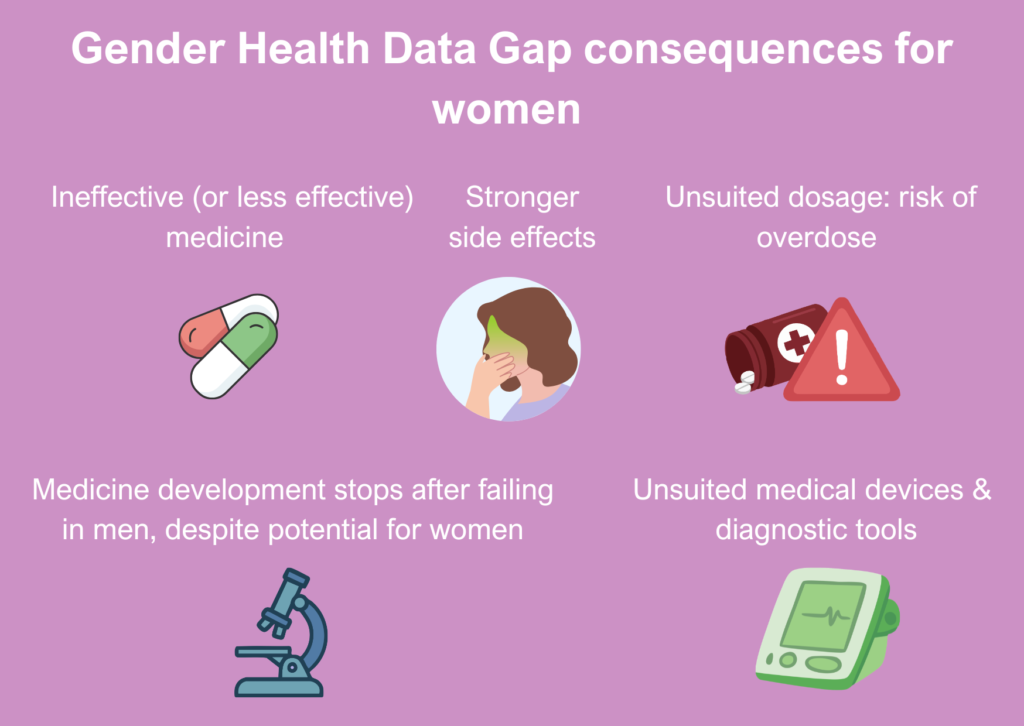
Despite representing more than half of the population, women are highly underrepresented in medical research. Moreover, gender-disaggregated results of clinical trials are usually absent. This leads to medicine, medical devices, diagnostic tools, surgery procedures etc. to be suited to male bodies but not to female ones. That gap ultimately results in poorer health and quality of life for women and, tragically, in deaths. This Opinion Piece is the first chapter of a series on women health. We begin where everything starts: medical research and clinical trials.
The default male
In her book from 2019 Invisible Women, Caroline Criado Perez, exposed a dire gender health data gap. She highlighted a systemic bias where medical research, diagnosis, and treatment are based predominantly on the male body, treating it as the standard. This view of men as the default human is deeply rooted in every aspect of society, however when it comes to health, this puts women’s lives at risk.
Historically, this bias has led to underrepresentation of women in clinical trials, resulting in misdiagnoses, inappropriate medication dosages, and delayed care for diseases that affect women differently or exclusively.
For decades, doctors and researchers (mostly men) thought that female and male bodies didn’t have any fundamental differences besides their size and reproductive functions. However, we now know that it is not the case and that female and male bodies function differently. What’s more, most diseases manifest differently and in different proportion in women and men. Some differences can even be observed down to the cell level.
This default male bias has been fueled by the fact that medicine and medical research have traditionally been dominated by men. Nevertheless, the proportion of women among doctors has increased significantly over the last two decades and women now represent the majority of doctors in the EU. However, for research, the picture is less bright. The proportion of women in research has hardly changed over the last decade. From 2011 to 2021, the share of women increased from 32.1% to only 33.7% in the EU (this figure is for all fields not only medical research).
Women remain underrepresented in clinical trials. This is due to reluctance from researchers and doctors to recruit women in clinical trials. Male researchers refuse to include women in trials because their bodies are seen as too complex, too variable due to hormonal changes and therefore too costly to include. Male researchers also say it is more difficult to recruit women in clinical trials because they have no time to participate due to their higher share of home and family duties.
Regarding pregnant women, they are routinely excluded from clinical trials due to safety and liability concerns. Besides, we can highlight that a higher proportion of women in researchers may not necessarily lead to more women recruited in clinical trials because women can also have a default male bias.
This lack of gender parity among clinical trial participants is already present in preclinical trials involving animals. Indeed, most of the animals on which we test medicine are male.
Importantly, even when there is an equal representation of women and men in clinical trials, it is rare that the trials have gender-disaggregated results, which makes this good representation useless.
This male bias in research also leads to a chronic lack of research on conditions that affect only women. As an example, erectile dysfunction (which affects 19% of men) is studied in research five times more often than Premenstrual Syndrome, (which affects 90% of women).
Current EU policies to close the gender health data gap
The EU has adopted several policies regarding clinical trials, yet gender-specific provisions remain limited.
2014 and 2022: The EU Clinical Trials Regulation
The Clinical Trials Regulation which was first adopted in 2014 and then updated in 2022 mandates that “unless otherwise justified in the protocol, the subjects participating in a clinical trial should represent the population groups, for example gender and age groups, that are likely to use the medicinal product investigated in the clinical trial.” This means that if a medicine is intended to treat both men and women, then there should be a gender parity in participants. The Regulation also tightly regulates inclusion of pregnant and breastfeeding women and the conditions for their participation in clinical trials.
2017: The Medical Devices Regulation and the In-Vitro Diagnostics Regulation
The 2017 Regulation on Medical Devices states that the application form for clinical investigation must contain information on the gender of subjects and sets additional conditions for clinical investigations on pregnant or breastfeeding women. The In-Vitro Devices Regulation states that for self-testing devices, “information shall be provided as to any factors that can affect the test result such as gender and menstruation”.
These two regulations are currently being revised. In December 2025, the Commission published its proposals for revised texts. However, no additional provisions on gender are included in the Commission’s proposals except to tighten conditions to conduct a clinical investigation on pregnant and breastfeeding women.
European Medicine Agency’s approval procedure
The European Medicine Agency’s approval procedure follows the guidelines of the International Council for Harmonisation of Technical Requirements for Pharmaceuticals for Human Use:
- Guideline E8: requires study populations to be representative of the target population, which includes appropriate gender representation.
- Guideline E3 and M4E: call for the characterization of the patient population, including gender, and analysis of data by sex to identify differences in safety and efficacy.
- Guideline E1: focuses on the inclusion of pregnant and breastfeeding individuals to improve evidence-based decision-making and product labeling.
2026: Action plan for women in research, innovation and start-ups
The Commission has launched, in January 2026, consultations for an EU’s action plan for women in research, innovation and startups. The Plan will address persistent gender gaps and promote diversity, equality and inclusiveness in the European Research Area and make the EU the world’s most attractive place for women to work in research. Scheduled for the second quarter of 2026, this plan may be a good opportunity to increase the proportion of women in medical research, which could foster the development of gender-specific medical research.
Is it enough?
To effectively address the lack of health data on women, it is crucial to enforce and monitor the implementation of the Critical Trials Regulation, a call echoed by the European Institute of Women’s Health. The Institute also advocates for the development of guidelines to ensure the inclusion and consideration of women for ethics committees at the national level. When researching this opinion piece, it was impossible to find recent statistics online about the participation of women in clinical trials in the EU, which raises concerns about the implementation of the Critical Trials Regulation, four years after its entry into force. Another concern about this Regulation is the lack of details of what constitutes a valid justification when a specific gender is excluded from or underrepresented in a clinical trial. Annex I, paragraph (y) merely states that a justification and explanation must be provided, which opens the door to unreasonable explanations.
An outstanding issue relates to existing medicines, devices and medical tools that are used systematically and identically for men and women. It appears that these medicines, devices and procedures should be re-evaluated to determine their effectiveness and dosage in women. As an example, research shows that for high-sensitivity cardiac troponin test (a blood test to diagnose heart attacks) the troponin threshold should be lower for women than for men. This highlights the need to formally include gender-specific thresholds in guidelines to ensure accurate diagnosis in women.
This reassessment of medical practices raises the question of the training of current doctors (both men and women) and how to update their knowledge as we obtain more scientifically proven gender-specific health data. Indeed, the training of doctors has been and remains largely focused on the male body. This often leads to misdiagnosis or lack of diagnosis in women (and therefore inappropriate treatment), particularly for diseases whose symptoms tend to differ between women and men (such as cardiac arrest) or for gender-specific conditions (such as endometriosis). All the best clinical trials and gender-specific medical research will be useless if they are not applied to drug development and medical practice.
If you read this article as a pharmaceutical or MedTech company, of course it is essential to comply with the regulatory framework we mentioned for legal reasons. But ensuring adequate gender representation and analysing gender-disaggregated results in your clinical trials goes beyond regulatory compliance. It builds reliability and trust in your product (and your brand) for more than half of your potential customers. In fact, for medicines, women represent the majority of your customers.
At Lykke Advice, we can help your company or organization navigate the EU regulatory landscape, gain visibility among European policy makers and position your company as an expert, credible and recognized voice. While it is not a silver bullet, having a product that is suitable for both men and women will be an advantage, as awareness of the gender health data gap is growing in Brussels.
