

In this year’s State of the Union speech Commission President Ursula von der Leyen highlighted a striking statistic: according to International Monetary Fund estimates, the internal barriers within the Single Market are equivalent to a 45% tariff on goods and a staggering 110% tariff on services. Such figures are startling for what is meant to be a ‘barrier free’ Single Market, the EU’s flagship achievement, yet they reveal inefficiencies that erode its credibility and global competitiveness.
Start-ups and SMEs form the backbone of the European economy, representing 99.8% of all businesses and 65.2% of jobs in the EU (2023 figures). Yet they remain disproportionately constrained by hidden barriers within the Single Market. Persistent regulatory fragmentation continues to limit cross-border activity, making it difficult for younger companies to expand beyond their home markets. At the same time, access to risk capital remains insufficient: the EU attracts only 5% of global venture capital, compared to 52% in the US and 40% in China according to the European Competitiveness Compass statistics. Combined with uneven innovation support across Member States, these obstacles undermine the EU’s ability to nurture and scale its most promising firms.
This disparity feeds into a vicious cycle of lower growth prospects and higher cost of failure which makes European Start-ups less attractive to investors, pushing many entrepreneurs to seek financing abroad. As Leticia Goretti, CEO of an Italian gene-editing company observes, Europe lags significantly behind in specialized start-up funding where only a handful of investors exist compared to thousands in alternative markets. Consequently, a considerable number of European startups begin in an EU Member State but ultimately relocate to the US or China, where access to capital is more abundant, bureaucracy is lighter, and scaling is far less complicated. A striking case is Lovable, a fast-growing AI startup from Stockholm that chose to incorporate in Delaware to benefit from easier access to venture capital and a more favourable regulatory and tax environment. Unfortunately, this is not an isolated example. These systemic barriers risk turning Europe into an innovation incubator that primarily benefits other markets, while its own entrepreneurs struggle with bureaucratic obstacles and fragmented funding channels.
Since the start of Ursula von der Leyen’s second mandate, the Commission has placed a strong emphasis on competitiveness and job creation. In February 2025, it introduced the Competitiveness Compass, a strategic framework to guide policy initiatives aimed at strengthening the EU’s economic performance. Building on the recommendations of the Letta (2024) and Draghi (2024) reports, which identified the priorities for the future of the Single Market and restoring Europe’s competitive edge, the Compass focuses on two main objectives: streamlining the regulatory landscape and enhancing coordination between EU and national policies. These goals are translated into concrete flagship actions, including closing the innovation and investment gap, advancing a coordinated strategy for competitiveness, reducing strategic dependencies, and reinforcing economic and technological security.
Complementing these efforts and addressing the challenges outlined above, on May 8th, 2025, the Commission put forward a Start-up and scale up strategy with the aim of making Europe a great place to launch and grow global technology-driven, innovative companies and resolve some of the core issues SMEs face. The strategy provides a series of legislative, political, and financial support measures to promote European start-ups and scale-ups at the EU level as well as inside the Member States.
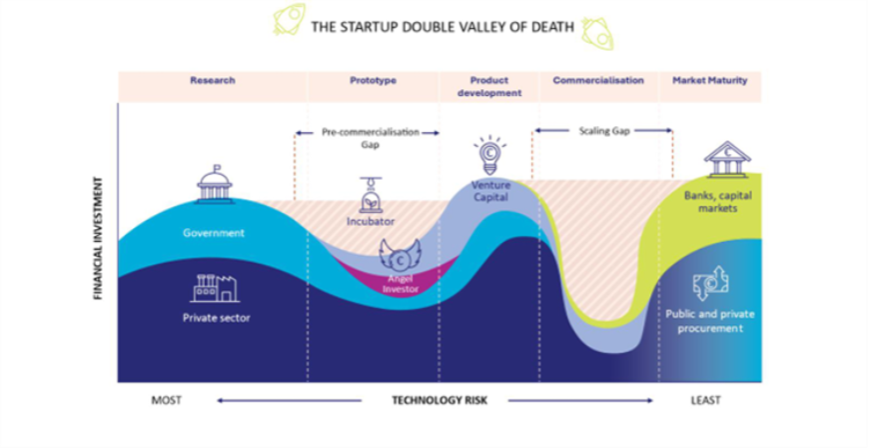
The strategy states that the European startups often encounter two ‘valleys of death’ (Figure 1). The first occurs when innovations fail to become marketable products, while the second, particularly challenging in Europe, happens when companies struggle to scale. Between 2008 and 2021, nearly 30% of European ‘unicorns’ relocated outside the EU, and only 8% of global scale-ups are based in Europe. Europe risks falling behind in strategic technologies, as it struggles to retain and attract high-potential technology scale-ups.
Source: Start-up and scale up strategy
The strategy mainly revolves around 4 outstanding issues: European talent pool, investment, red tape and fast market uptake and expansion, each outlining the corresponding policy solutions.
- European Talent Pool:
European startups face significant talent barriers, including complex recognition of qualifications, underused academic expertise, gender imbalance, and limited diversity. Smaller firms often cannot match the salary and benefits of larger companies, and differing tax regimes for employee stock options further hinder their ability to attract and retain skilled workers. At the same time, weak entrepreneurial education reduces the future pool of innovators and reinforces these structural challenges.
To strengthen Europe’s talent base, the Commission will launch the Blue Carpet Initiative, aimed at attracting and retaining highly skilled professionals from both within and beyond the EU. The initiative will promote entrepreneurial education and gender balance in the innovation ecosystem, support the commercialisation of research, and explore greater harmonisation of stock options and tax rules for cross-border work. It will also advance fair labour mobility through clearer social security coordination, faster qualification recognition, and more accessible legal pathways, including an EU Visa Strategy and pilot “Legal Gateway Offices” for Information and Communications Technology specialists. Awareness campaigns on the EU Blue Card Directive will further enhance Europe’s appeal to global talent.
- Investment:
According to the European Investment Bank’s report on the scale-up gap Europe’s financial system remains predominantly bank-based, with bank assets representing 300% of EU GDP versus 85% in the US, leaving firms overly reliant on debt rather than equity. Fragmented capital markets, divergent insolvency and tax rules, and varying listing standards restrict cross-border investment and exit opportunities, pushing many innovative companies to scale-up abroad. Europe’s business angel ecosystem also struggles with barriers to cross-border financing and rigid capital-lock practices, limiting early-stage growth.
Furthermore, the European Parliament’s Report on access to finance for SMEs and scale-ups highlights a major funding shortfall persists for high-risk, capital-intensive scale-ups requiring over €100 million, jeopardising both the retention of European-grown firms and control over critical technologies. To address this, a large-scale European scale-up fund operating on market terms is needed to safeguard economic security and technological sovereignty. In parallel, the Commission is exploring the expansion of ETCI 2.0, an ambitious fund-of-funds structure pooling private and public capital, while ensuring strong complementarity with the new Scaleup Europe Fund to maximise impact and flexibility. Finally, the ongoing revision of the Foreign Direct Investment Screening regulation aims to harmonise screening process across Member States and improve EU wide compensation.
- Red tape:
Regulatory fragmentation across Member States undermines the start-ups’ ability to operate effectively in the Single Market. Divergent rules on taxation, company and securities law, and labour regulations create administrative burdens and deter cross-border investment. High failure costs and uncertainty further discourage entrepreneurial risk-taking. At the same time, regulatory frameworks often struggle to keep pace with emerging technologies, slowing down approval processes and obstructing the deployment of disruptive products and services.
The European Innovation Act and the proposed 28th regime are designed to remove structural barriers by creating a unified, innovation-friendly regulatory framework for startups and scaleups. The 28th regime will introduce a digital-by-default set of corporate rules to simplify company creation and expansion across the Single Market, reducing administrative burdens, easing insolvency procedures, addressing tax and labour-law discrepancies, and lowering the cost of entrepreneurial failure. A core objective is to enable businesses to be established within 48 hours anywhere in Europe. Work is already progressing, on 8 July 2025, the Commission opened a public consultation on the initiative, with legislative proposals expected in early 2026 following an impact assessment.
Further, the implementation of the Insolvency Directive will simplify restructuring processes, lowering costs and uncertainty for entrepreneurs. In parallel, a forthcoming Tax Recommendation under the Clean Industrial Deal will encourage investment by promoting immediate expensing, accelerated depreciation, and targeted tax incentives for high-growth firms. Regulatory sandboxes will further support innovation by enabling real-world testing in collaboration with regulators, helping adapt rules to emerging technologies while fostering regional innovation ecosystems and investment.
- Fast Market Uptake and expansion:
The commercialisation of innovation in Europe depends on entrepreneurial drive, risk-tolerant capital, market demand, and effective public support. Universities are central to this ecosystem, having generated over 157,000 spinoffs and startups with strong job-creation potential. However, despite EU initiatives such as the Unitary Patent System and the European Institute of Innovation and Technology, the conversion of research into marketable ventures remains uneven. Weak incentives for academic commercialisation, fragmented frameworks for spin-offs, and risk-averse procurement practices continue to restrict startups’ access to markets and limit their ability to scale.
To build a more cohesive innovation ecosystem, the EU aims to reinforce university–industry collaboration, ensure full implementation of the Unitary Patent System, and reform procurement to make it more innovation-friendly. Strategic partnerships between startups and corporates, stronger territorial connectivity through cohesion policy, and improved access to global markets will further support scaling. Flagship initiatives such as the Lab to Unicorn programme will enhance cross-border collaboration between leading hubs, standardise Intellectual Property commercialisation practices, and strengthen Technology Transfer Offices, while new guidance will clarify State aid rules. Procurement simplification will also help innovative firms win contracts and grow more easily across the Single Market and beyond.
Beyond the Start-up and Scale-up Strategy, the 2025 SOTEU and the Commission’s Work Program 2026 placed a clear political emphasis on building an environment where innovative companies can grow and remain in Europe. President von der Leyen announced a series of major initiatives; including the Single Market Roadmap to 2028, the Industrial Accelerator Act, multiple Omnibus simplification packages, and the development of an EU Cloud and AI Development Act, all aimed at modernising the Single Market and unlocking the potential of critical technologies such as AI, quantum, and clean tech. These measures intend to streamline rules, support lead markets for circular and innovative products, improve access to venture capital, and ensure that European startups can find the regulatory certainty and financing they need without relocating abroad. Together, they constitute a comprehensive effort to transform Europe into a more dynamic, integrated, and globally competitive scale-up ecosystem.
Navigating the rapidly evolving EU landscape for start-ups and scale-ups requires not only a deep understanding of complex EU regulations but also strategic foresight to leverage emerging opportunities. This is where our consultancy Lykke Advice, specialized in helping SMEs, can provide significant value. By monitoring policy developments, interpreting legislative proposals such as the upcoming 28th Regime and identifying funding streams and innovation incentives, we help start-ups and scale-ups make informed strategic decisions. Beyond compliance, our consultancy can craft targeted public affairs strategies, engage with key EU institutions, and build coalitions with relevant stakeholders, ensuring that companies not only operate effectively within the Single Market but also maximise growth, investment, and scaling potential across Europe.
