

Artificial Intelligence (AI) is advancing at an unprecedented pace, reshaping the way Europe approaches industrial activity, public services, and global competitiveness. Yet, despite Europe’s vibrant ecosystem of SMEs and start-ups, AI adoption across the European Union remains limited. Only 13.5% of EU businesses have integrated AI solutions into their operations, with just 12.6% of these being SMEs.
While European researchers were among the first to embrace AI in their work, China and the United States have surged ahead in recent years. The EU’s share of global AI computational capacity has been lagging below 5%, compared to 75% in the U.S. and 15% in China.
From the AI Act to the AI Continent Plan
Over the past decade, Europe’s global competitors and partners, notably the U.S., China, the U.K., and Japan, have invested heavily in AI development and deployment. Europe, by contrast, has often prioritized regulation over innovation. The landmark AI Act, adopted in 2024, positioned the EU as the first region to introduce comprehensive AI legislation. However, this regulatory success has not yet translated into global competitiveness.
To bridge this gap, the European AI Continent Action Plan, launched in April 2025, seeks to combine Europe’s scientific and industrial strengths with enhanced data, infrastructure, and regulatory trust. Among its flagship initiatives is the creation of 13 AI factories and 5 AI gigafactories across Europe.
These facilities are designed to provide the computing power, infrastructure, and tools needed to scale up AI innovation, particularly for start-ups and SMEs that lack such capacity on their own. In few words, AI factories are regional hubs offering access to powerful computing systems, high-quality data, and technical expertise, allowing smaller companies and research teams to develop, test, and deploy AI solutions without having to build expensive infrastructure themselves.
AI gigafactories, on the other hand, represent the next level: large-scale, pan-European facilities capable of training advanced AI models that require massive computing resources. They host tens of thousands of AI-optimised chips, supercomputers, and data storage systems, providing Europe with the means to compete globally with the U.S. and China in AI development.
Together, these infrastructures aim to democratise access to AI, reduce Europe’s dependence on foreign technologies, and strengthen the continent’s capacity to innovate responsibly and at scale.
To complement this effort, the European Commission unveiled in October 2025 two ambitious strategies aimed at accelerating the deployment of AI across research and business:
- The Apply AI Strategy, designed to boost industrial competitiveness and technological sovereignty;
- The AI in Science Strategy, aimed at harnessing AI’s potential to revolutionize scientific research.
The Apply AI Strategy
The Apply AI Strategy aims to enhance the competitiveness of Europe’s strategic sectors while strengthening the EU’s technological sovereignty. Its overarching goal is to accelerate AI adoption and innovation across Europe, with a particular focus on SMEs.
As highlighted by Henna Virkkunen, Executive Vice-President and Commissioner for Tech Sovereignty, Security and Democracy, the adoption of AI will “empower European enterprises to increase operational capacity, lower costs, create new business opportunities, and improve public services for citizens”.
The EU holds significant advantages for AI deployment: leadership in industrial automation and smart manufacturing, a vibrant ecosystem of AI-driven start-ups and a rapidly expanding computing infrastructure sustained by the construction of AI gigafactories.
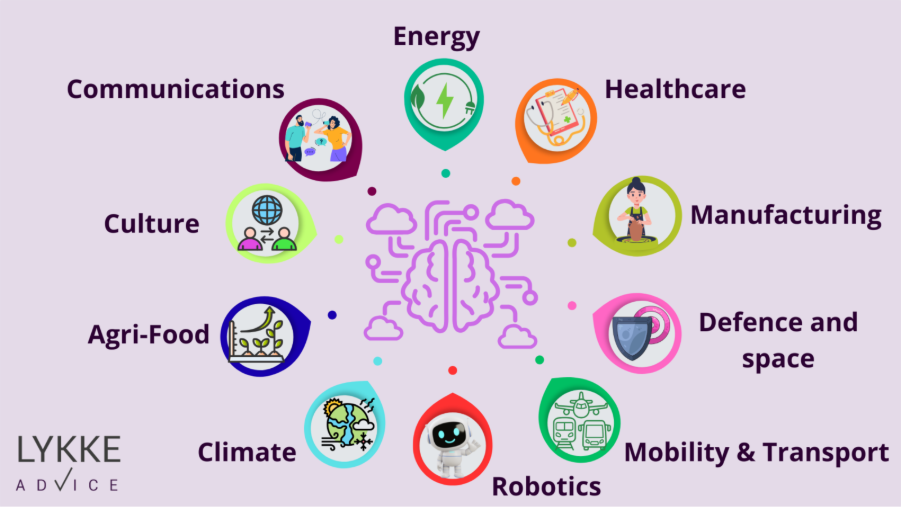
A crucial aspect of the Strategy is its sectoral approach, ensuring coherence with the EU’s existing and forthcoming legislative framework. The Strategy focuses on accelerating the use of AI across ten key industrial sectors and the public sector.
Healthcare and pharmaceuticals
In healthcare, AI has the potential to revolutionize early prevention, diagnosis, and treatment. For this reason, the Commission will establish AI-powered advanced screening centres across Europe to accelerate the introduction of innovative tools for prevention and diagnosis, while improving access to healthcare services in underserved areas.
These centres aim to improve early detection of diseases such as cancer and cardiovascular conditions, ensuring timely diagnosis and equitable access to care. AI-powered screening and diagnostics will also consider gender-specific factors, ensuring fairness and inclusivity.
The adoption of such technology could indeed mark a significant step forward for European healthcare systems. By implementing effective early detection and screening programmes, supported by innovative solutions based on AI, Europe can better prevent the occurrence of non-communicable diseases. This would save lives, alleviate pressure on hospitals, and reduce costs for the entire economy, both in terms of direct healthcare expenditure and the loss of competitiveness caused by people being ill or dying prematurely. In many fields, the application of AI is already making possible what, only a few years ago, seemed unimaginable. Therefore, it is essential for the European Union to acknowledge and actively encourage research and deployment of these technologies, not only for scientific advancement but ultimately for Europe’s competitiveness and the well-being of its citizens.
The initiative will leverage the European Health Data Space and the European Digital Infrastructure for Cancer Imaging, while complementing the European Beating Cancer Plan, the Life Sciences Strategy, and the upcoming European Cardiovascular Health Plan.
Furthermore, AI will play a crucial role in drug discovery and development. Through AI-based modelling and simulation, pharmaceutical companies can accelerate the discovery of new treatments and repurpose existing drugs to address unmet medical needs, such as Alzheimer’s disease and rare cancers.
Robotics, manufacturing, engineering, and construction
Europe is at the forefront of the global robotics revolution. EU developers are leading innovations in cognitive and industrial robotics, with applications ranging from education and healthcare to defence and construction.
Collaborative robots are transforming workplaces, enhancing safety, addressing labour shortages, and reducing worker exposure to hazardous environments. The Apply AI Strategy recognises robotics as a cornerstone of Europe’s technological leadership, supporting the creation of a European Robotics Catalyst to bring together developers and industrial users.
The Commission will also finance Acceleration Pipelines for AI-powered robotics to ensure innovation aligns with market and societal needs. A particularly transformative technology in this field is the AI-powered digital twin; virtual models that allow companies to simulate real-world processes, test “what-if” scenarios, and optimise operations before implementation. These tools are expected to boost productivity, reduce costs, and shorten time-to-market, making European manufacturing and engineering more competitive and resilient.
Defence and space
As security and defence are one of Europe’s top priorities for the years to come, in the same spirit they are set to be central pillars of Europe’s AI transformation. AI already plays a vital role in modern warfare, situational awareness, and cyber operations, powering satellite systems, radar networks, and unmanned vehicles.
Building on the European Defence Fund (EDF) and the SAFE financing instrument, the Apply AI Strategy will accelerate the development of AI-enabled situational awareness and command-and-control (C2) capabilities. The strategy will also promote dual-use open architecture solutions for border security and critical infrastructure protection.
In parallel, the EU will invest in AI factories and gigafactories dedicated to defence and space applications, ensuring compliance with European cybersecurity standards and reducing dependence on non-EU suppliers.
Additionally, the Commission will support the deployment of AI-based cybersecurity tools and services capable of threat detection, vulnerability mitigation, and system interoperability, strengthening Europe’s internal security and resilience.
Energy
AI offers enormous potential to enhance energy efficiency and grid management across the entire value chain. Yet, its adoption in the energy sector remains uneven.
The Apply AI Strategy seeks to develop AI models for forecasting, optimisation, and system balancing, thus enabling a smoother integration of renewables and improving infrastructure planning. The forthcoming Strategic Roadmap on Digitalisation and AI for the Energy Sector and the Cloud and AI Development Act will address how to ensure the energy resources needed for AI itself, for example, by improving the efficiency of data centres and computational infrastructure.
Agri-Food sector
Although agriculture and food production remain among Europe’s most traditional sectors, they have increasingly embraced precision farming and agritech solutions. AI-driven tools are helping farmers use resources more efficiently, optimise irrigation, and reduce environmental impact.
The European Commission plans to establish an Agri-Food AI Platform to promote specialised farming tools and digital applications, supported by the upcoming European Biotech Act and the Bioeconomy Strategy. These measures are meant to boost productivity, encourage sustainable practices, and advance Europe’s transition towards a circular bioeconomy.
Yet, despite these initiatives, the Apply AI Strategy appears to lack ambition when it comes to agriculture. Announcing the creation of a platform, while acknowledging that farmers remain sceptical about adopting AI and digital technologies, is a weak response to a deeply rooted challenge. In other words, such measures do not address the problem at its source. What the sector truly needs is greater investment in agritech and digital solutions to ensure they can be scaled up effectively. Only by demonstrating tangible results, in terms of increased competitiveness, time savings, cost reductions, and environmental benefits, the AI adoption will become self-sustaining and naturally incentivised among European farmers.
SMEs and the “AI-First” policy
One of the most positive aspects of the Strategy is without any doubt its strong focus on supporting SMEs, which often face barriers to adopting and implementing AI in their daily operations. To help bridge this gap, the Commission will invest an additional €1 billion in funding, supplementing existing EU investments in AI development and cloud capacity building. Recognising that SMEs require tailored, sector-specific solutions, the Strategy ensures that companies receive impartial guidance and access to the right tools for their needs.
Under the Strategy, the over 250 European Digital Innovation Hubs will be repurposed into AI Experience Centres, serving as local access points for expertise, training, and experimentation. SMEs will be able to access these centres to receive tailored support in their digital and AI transition, helping them adopt AI tools in their daily administrative and production processes, or even scale up and advance their use of AI in more sophisticated business applications. Beyond technical assistance, these hubs will also foster networking and collaboration by connecting SMEs with counterparts across other European countries, facilitating both intra-sectoral and cross-sectoral cooperation.
Indeed, to stimulate the development of home-grown AI technologies, the Commission will launch a call for expressions of interest inviting European companies and SMEs to share their AI tools and systems with the Digital Innovation Hubs, thereby promoting their deployment across European strategic sectors. In essence, the overarching goal is to build a single market for European AI, scaling up locally developed solutions to the continental level.
Finally, with regard to the public sector, the Strategy promotes a “Buy European” approach, encouraging public authorities to prioritise open-source, European-made AI solutions, thereby strengthening Europe’s technological sovereignty and digital resilience.
AI Act compliance and skills development
Two main obstacles hinder AI deployment in Europe: a lack of skills and a lack of clarity and trust in regulatory requirements. To address the first, the Commission will expand the AI Skills Academy, created under the Union Skills Strategy, to offer practical training tailored to specific sectors and professions. To address the second, the Commission will issue guidelines on the classification of high-risk AI systems and on the interplay between the AI Act and sectoral EU legislation, providing clarity for companies and regulators alike.
The second pillar: AI in Science Strategy
Beyond industry, AI is also transforming the way scientific research is conducted, from automating experiments to analysing vast datasets. To seize these opportunities, the Commission’s AI in Science Strategy outlines a coordinated approach to make Europe a global leader in AI-driven research.
At its core is the Resource for AI Science in Europe (RAISE), a virtual institute designed to pool talent, infrastructure, and expertise. Scheduled for launch during the AI in Science Summit in Copenhagen (3–4 November 2025), under the Danish Presidency of the EU, RAISE will be equipped with €108 million from Horizon Europe and supported by both Member States and the private sector.
RAISE pursues two complementary goals: advancing AI research itself and promoting the use of AI in scientific progress across all disciplines. To this end, it will create Thematic Networks of Excellence and a European Network of Frontier AI Labs, bringing together researchers, start-ups, and private actors across scientific fields.
Talent and infrastructure
The strategy also includes a strong talent dimension. In line with the Choose Europe Package, €58 million will be allocated under the RAISE pilot for doctoral networks and training programmes, designed to attract, retain, and nurture AI and science talent in Europe.
Additionally, over €600 million will be mobilised from Horizon Europe to boost access to computational capacity for scientific research. Dedicated access to AI gigafactories for researchers and start-ups will further strengthen Europe’s scientific capabilities.
AI in key scientific sectors
The Strategy identifies two sectors where AI is already driving major breakthroughs: advanced materials and biotechnology.
In materials science, AI enables innovation across the entire lifecycle, from discovery to manufacturing, supporting advanced manufacturing techniques and contributing to Europe’s dual civil-defence industrial base. To ensure governance and coordination, the Commission plans to present a European Advanced Materials Act in 2026.
In biotechnology, AI supports progress in drug discovery, molecular design, and fermentation processes. However, this rapid evolution also demands strong collaboration between policymakers, scientists, and ethicists to ensure trust, safety, and accountability in AI use. To this end, the Commission is also expected to present a new European Biotech Act which, according to Ursula von der Leyen will “capitalise on the upcoming biotech revolution through biotechnologies, supported by AI and digital tools, which can help modernise entire parts of our economy, from farming and forestry to energy and health”.
Why this matters for SMEs
The Apply AI and AI in Science strategies mark a turning point for the European economy. They bring unprecedented financial, technical, and policy support for European enterprises ready to embrace AI.
For SMEs selling AI based solutions, this is an opportunity to scale up and expand. For those that have not yet taken the leap, it represents a unique chance to explore the benefits and position themselves at the heart of Europe’s next industrial revolution.
For European SMEs, now is the time to engage, learn, adopt, and lead, as the European Commission rolls out these landmark strategies that will shape the regulatory, technological, and industrial landscape for years to come.
Lykke Advice is a boutique public affairs consultancy based in Brussels, established with the aim of helping SMES navigate the EU landscape and seizing the opportunities Brussels can offer them. With almost 10 years of consolidated experience, we can help your SMEs thrive and expand markets across the EU, besides raising awareness in Brussels to make sure the new legislations are aligned to your business priorities.
