


What is the Transparency Register?
The Transparency Register is a public database that lists organisations seeking to influence the law-making and policy implementation process of the EU institutions. The register makes visible what interests are being pursued, by whom and with what budgets.
Who must register?
Any organisation that intends to shape EU policies, legislations and/or decision-making processes must register. That includes companies, business associations, trade unions, NGOs, research institutions, consultancies, think tanks, religious organisations etc. This means that in addition to industry players, the EU institutions recognise that activists also lobby for their interests and seek to influence the legislative process. Lobbying activities encompass (not exhaustively):
- organising or participating in meetings, conferences or policy events
- participating in consultations or hearings
- organising communication campaigns, platforms, networks or grassroots initiatives
- preparing or commissioning policy and position papers, amendments, opinion polls, surveys, etc.
It is important to keep in mind that the aim of the Transparency Register is to show organised and/or collective interests, not personal interests of individuals. It’s also worth noting that activities that do not seek to influence, but rather to follow or monitor EU law or policy are not required to register.
Is it mandatory?
It is mandatory for interest representatives’ organisations to be in the Transparency Register if they want to:
- request access authorisations to European Parliament premises
- be invited to speak at Parliament’s committee hearings
- be able to participate in intergroups and other unofficial groupings activities organised on Parliament premises
- meet the Secretary-General and Directors-General of the General Secretariat of the Council
- participate in thematic briefings for interest representatives organised by the General Secretariat of the Council
- participate as speakers in public events organised by the General Secretariat of the Council
- meet Commissioners, members of their cabinets and Directors-General of the Commission. In practice, this means that you are always asked for your Transparency Register Identification number before meeting a commissioner or a member of his/her cabinet.
- be invited to join Commission expert groups
Statistical overview
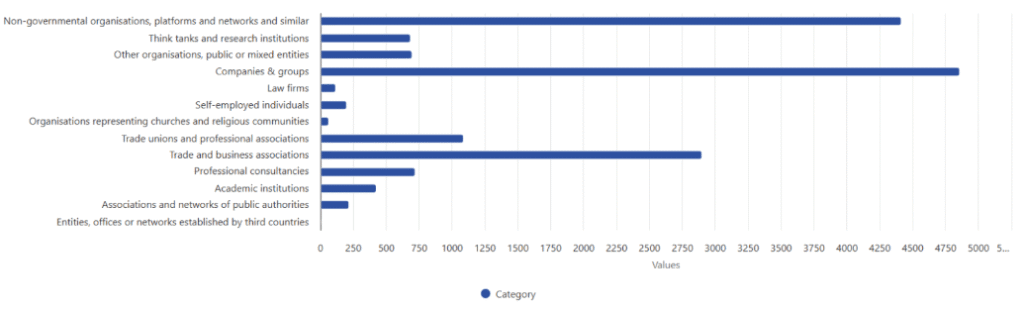
According to the statistics page of the Transparency Register, as of 24th November 2025, there are 16,364 organisations in the Transparency Register. As we can see in the graph below, the greatest share of registered organisations are companies with 4,875 registrants followed by NGOs with 4,450 registrants.
If we break the numbers in categories of what type of interests do the organisations represent, we can see that 67% of organisations represent their own interests, while 28% do not represent commercial interests and 5% are advancing the interests of their clients. These percentages are explained by the fact that the category, “organisations representing their own interests” aggregates actors such as companies, business associations and trade unions.

Which information must be entered?
It should be underscored that all information put in the Register is public and accessible by any person with an internet connection. The information is provided by the registrants themselves, and they are ultimately responsible for its accuracy.
An annual update is mandatory, but the information should be updated whenever relevant. Registrants who fail to do their annual update on time are suspended from the Register. In fact, the removal and sanctions for repeated non-compliance in the last couple of years have showed a shift toward more strict enforcement. The 2nd of April 2024 revision of the Transparency Register introduced notable updates. One significant development is the new automated cross‑check feature between clients and intermediaries, which enhances the accuracy and reliability of the reported data. Another notable change is the “newly formed” category which allows recently established organisations to report estimated data for certain fields for up to 24 months, providing flexibility while maintaining accountability.
Depending on the kind of interests your organisation represents, you do not have to enter the same financial information to the Register.
| Mandatory financial information for everyone |
| 1. Most recent financial year closed: may not coincide with a calendar year 2. EU grants: amount and source (relevant programme and funding authority) of any EU grants contributing to their operating costs. |
| Represent own interests or collective interests of your members Companies, business associations, trade unions | Represent the interests of your clients Consultancies, law firms | Do not represent commercial interest NGOs, foundations, academic and research institutions, think tanks, churches |
| 1. Any intermediary hired to carry out covered activities (names and associated annual cost) 2. Your annual costs in relation to covered activities by the Register: staff costs, office and administrative expenses, in-house operational expenditure, representation costs, outsourced activity costs, membership and related fees | 1. Your clients (names and associated revenues and legislative proposals, policies or initiatives for each client) 2. Your total annual revenues. (PS: The Register automatically calculates this amount on the basis of the aggregate sum of the estimated revenue generated per client.) | 1. Your main sources of funding by category: EU funding, (national) public financing, grants (including EU grants), donations and members’ contributions. You can select several categories. 2. The amount of each contribution above €10 000 exceeding 10 % of your total budget and the name of the contributor 3. The total budget for the most recent financial year closed: entire budget (not only funds for activities covered by the Register). |
According to the special report on the Transparency Register by the European Court of Auditors, between 2021 and 2023, the EU awarded over €7 billion in funding to NGOs, yet this support remains highly fragmented, with more than 90% of recipients not clearly categorized. Disclosure of advocacy or lobbying activities financed by these grants is often weak, and the system’s reliance on self-declaration without verification creates legal uncertainty and increases the risk of misuse. These inconsistencies in financial reporting requirements have fuelled criticism from multiple sides. While some argue that NGOs should be under tighter scrutiny others argue, on the contrary, that companies and business associations observe fewer transparency obligations than non-for-profit organisations and often bypass them. In the aftermath of the Qatargate scandal, in which NGOs were used as a cover to bribe and carry out non-transparent lobbying, the EPP Group called for a financial pre-screening of NGOs before they are listed in the transparency register and the publication of contractual agreements between NGOs and the European Commission. To which Iratxe García Pérez, the President of the S&D Group, answered that an NGO witch-hunt won’t solve the issue and only diverts from the disproportionate role that corporate lobbying plays in the EU’s legislative process.
One option is to introduce equal transparency register requirements for all organisations, allowing for a fairer comparison between actors. This would lead to more transparent lobbying practices in Brussels, in alignment with why the Register was established 30 years ago. Nevertheless, since the Qatargate scandal, some other positive steps have been taken: the EU adopted its first-level definition of NGOs, and Commission guidance now forbids requiring lobbying as part of grant agreements. Looking ahead, from 2028 a single data gateway will consolidate EU funding information from Member States, while ensuring that smaller organizations receive adequate support to comply without being overburdened.
On the other hand, gaps also remain regarding lobbying by companies representing their own interest. Oversight is constrained by limited enforcement capacity, with just 11 full-time staff monitoring compliance in the Unit of Transparency and conflict-of-interest safeguards remain weak, with cooling-off periods for former officials considered insufficient. For example, former MEPs are only barred from lobbying for six months after leaving office, a period widely criticised as purely symbolic given that legislative activity is typically low at the start of a parliamentary term, allowing them to resume influence almost immediately thereafter. This undermines the credibility of the Transparency Register because it fails to prevent the “revolving door” phenomenon of ex-officials using their inside contacts to influence EU policymaking soon after leaving office. Furthermore, unregistered actors continue to exert influence on policymaking, while narrow reporting definitions mean that only high-level, pre-scheduled meetings are formally disclosed. These weaknesses are illustrated by this year’s case in which representatives of U.S. conservative think tank The Heritage Foundation, authors of Project 2025, met with Members of the European Parliament without registering in the Transparency Register, highlighting the persistent risk of untracked external influence on EU policymaking.
In an effort to push forward transparency and address this issue, the new conditionality and complementary rules under the EU Transparency Register came into effect on the 1st of September 2025. They are intended to strengthen the link between registration and access to key meetings, by ensuring that only fully transparent actors can engage with EU institutions. Under these rules, the European Parliament now requires interest representatives to be registered and active in order to meet certain senior staff, such as Directors-General or team leaders in Cabinets. Similarly, since 2025, the European Commission mandates registration for meetings with its managers, including Directors-General and Heads of Unit. Importantly, these meetings are published publicly, through meeting minutes, further enhancing transparency.
In all instances, Lobbying is much more than having a Transparency Register Identification number for your organisation. Being registered is only the first step to have access to EU institutions. As a Brussels-based consultancy, Lykke Advice helps organisations navigate the EU bubble by identifying how upcoming legislation may affect them and developing tailored lobbying strategies to achieve their advocacy goals. Our commitment to transparency is central to this work, we require all clients engaging with EU institutions to be registered in the EU Transparency Register and subsequently include them in our own internal register upon contract execution. We believe that transparency should apply equally to all stakeholders, enabling companies to understand which other clients a consultancy represents when seeking external support. If you would like to learn more about our services or how to influence the political process to ensure legislation supports your interests, please feel free to contact us.
