


This opinion piece is part of a series on women’s health. After a first article on the vast gender health data gap in clinical trials and medical research and a second one on reproductive health, this final article focuses on diseases that disproportionately affect women.
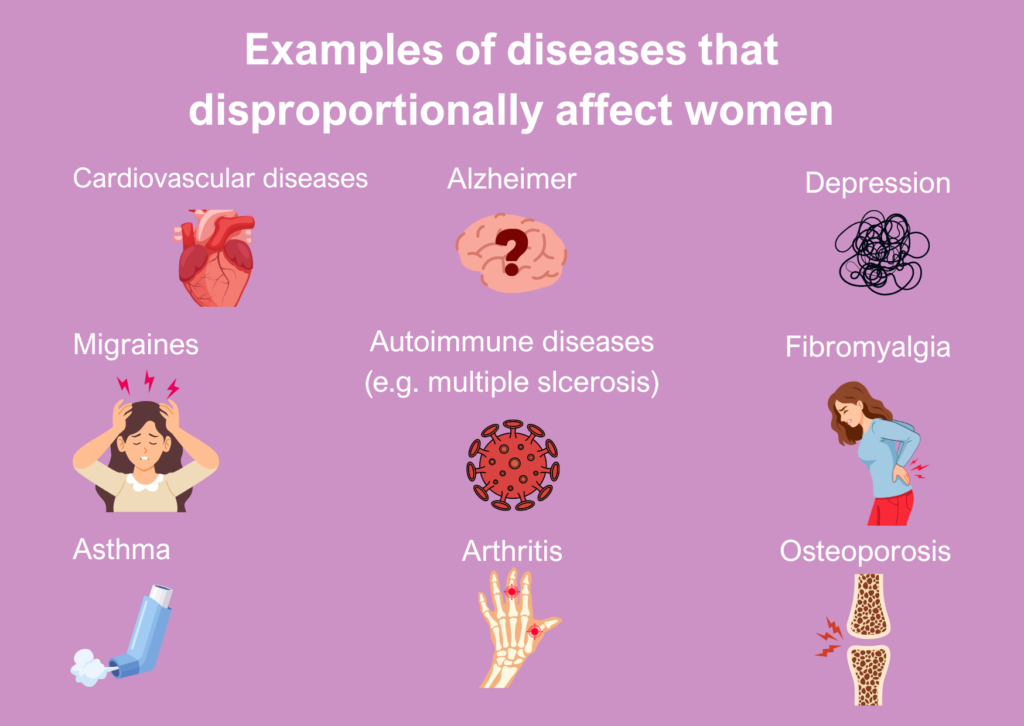
Beyond some gender-specific diseases, such as cervical cancer for women or prostate cancer for men, some diseases concern both genders but disproportionally affect women due to genetic, hormonal, and immunological factors. Moreover, women often suffer from misdiagnosis as some symptoms manifest differently in men and women. This is the case for heart attacks, which in men often present with chest pain or pressure, whereas in women it may more often present with shortness of breath, nausea, unusual fatigue, and pain in the back, jaw, neck, shoulder or arm.
Neurological and mental health
In 2025, women continue to bear a disproportionate share of the burden of neurological and mental health conditions in Europe. Dementia is a striking example, with 8,009,313 women and 4,113,666 men living with dementia in EU27 and non-EU countries combined. The reasons behind this enormous discrepancy are primarily attributed to the fact that women live longer than men, and elderly age is the greatest risk factor for Alzheimer’s related dementia. Yet researchers are now questioning whether this higher risk for women could actually be due to biological or genetic factors, such as women possessing a stronger immune system.
The same gender imbalance is observed in mental health. Eurostat’s 2019 European Health Interview Survey found that 8.7% of women in the EU reported chronic depression, compared with 5.5% of men. Several factors can explain this: differences in hormones, socialisation, social roles, coping mechanisms, and stressful life events. However, it is also known that women are more likely to seek help and that depression may present differently in men, which may mean that men are often underdiagnosed or misdiagnosed.
Migraines tell a similar story: in the EU, they affect 11.5% of the population, but women are two times more likely to suffer from them than men, particularly between the ages of 30 and 39. Nearly half of affected women experience menstrual-related migraines, which are often more severe. These figures point to a clear and persistent reality: neurological and mental health conditions are not gender-neutral, and Europe’s policy response should not be either. While the European Commission’s 2023 comprehensive approach to mental health was a welcome step, it has not yet been followed by the level of sustained action this challenge demands. The EU now needs a dedicated Action Plan on neurological and mental health, backed by clear political commitment and specific funding from both national and EU budgets.
Cardiovascular heath
Cardiovascular disease remains one of the clearest examples of why women’s health can no longer be treated as a niche concern in European policymaking. It is the leading cause of death for both women and men, accounting for 40% of all deaths among women and 37% among men. Yet its impact on women is still too often underestimated: cardiovascular disease kills more women than all cancers combined. This is not only a question of prevalence, but also of recognition, diagnosis and care. Women are 20% more likely than men to die following a heart attack, partly because their symptoms are too often misrecognised. They wait more than five times longer than men to receive a heart failure diagnosis and are twice as likely to be misdiagnosed. Women experiencing chest pain are also more likely than men to wait over 12 hours before seeking medical help, reflecting both gaps in awareness and persistent failures in the health system.
In December 2025, the European Commission published the EU’s Safe Hearts Plan. It proposed investments under Horizon Europe to advance research into sex-and gender-specific mechanisms of cardiovascular disease, with indicative funding of EUR 40 million, are a necessary step. So are the planned EUR 2 million for a Cardiovascular Disease Research and Innovation Roadmap and the EUR 2 million under EU4Health to support targeted actions reducing cardiovascular disease and diabetes risks among vulnerable groups, particularly women. These commitments must now translate into concrete actions and require education and training of both patients and healthcare professionals.
Cancer
Cardiovascular diseases remain the leading cause of death for both women and men in Europe, followed by cancer. The picture changes dramatically when looking at premature mortality. Among women under the age of 65, cancer is by far the biggest killer. The burden is particularly visible in breast, colorectal and lung cancers, which remain the three most common cancers affecting women in Europe.
The EU has already recognised the scale of the challenge through the 2021 Beating Cancer Plan, including its ambition to develop a new EU Cancer Screening Scheme and ensure that, by 2025, 90% of the target population is offered breast, cervical and colorectal cancer screening. The Plan also set the objective of vaccinating at least 90% of the EU target population of girls against HPV and significantly increasing the vaccination of boys by 2030.
Yet ambition on paper is not enough. The European Court of Auditors has already pointed to uncertainty over cancer-related funding after 2027. At the same time, screening programmes still differ widely from one Member State to another: for example, free HPV testing is offered at age 35 in Czech Republic, whereas in France cervical cancer screening starts at 25.
More importantly, many screening programmes continue to fall short because participation has dropped and remains too low. The question Europe must now answer is not only how to offer screening, but how to make it easier for women to attend it, especially when they still carry a disproportionate share of care and household responsibilities. This could mean granting women one paid day per year to undergo cancer screening or creating multi-screening centres where mammograms, HPV tests and colorectal stool tests can be combined in a single visit. Europe must also pay greater attention to cancers that only affect women, such as ovarian and endometrial cancers, which remain too often overlooked in prevention, diagnosis and research. If the EU is serious about reducing premature deaths among women, cancer policy must move from access in theory to participation in practice.
Other diseases
Beyond cardiovascular disease, cancer, neurological conditions and mental health, many other diseases reveal the same imbalance. Autoimmune diseases are a clear example with women affected at roughly twice the rate of men, a figure that can be much higher for certain diseases such as multiple sclerosis. Respiratory disorders also show important sex and gender differences. Asthma is more common in boys before adolescence, but in adulthood the burden shifts, with higher prevalence among women than men. Rheumatological diseases and chronic pain conditions also disproportionately affect women. One of the most extreme examples is fibromyalgia, a chronic musculoskeletal disorder, with women representing between 80% and 96% of cases.
These imbalances are due to a mix of biological and social factors. Women’s stronger immune responses can increase vulnerability to autoimmune diseases, while hormones and genetic factors influence inflammation, pain, respiratory conditions and disease progression across the life course. At the same time, women’s symptoms are still too often dismissed, misdiagnosed or diagnosed late. The result is a health system that has not yet fully understood or adapted to diseases that disproportionately affect women.
Conclusion
Europe’s response must now match the scale of the challenge: the health of half the population has been overlooked. Women’s health needs a dedicated Strategy with earmarked funding, not fragmented initiatives or short-term commitments. It must also be understood across the entire life course, rather than reduced to pregnancy and reproductive health alone. From prevention and screening to diagnosis, treatment, research and workplace inclusion, women’s health should become a cross-cutting priority for EU and national policies. This means investing in organised prevention, improving health literacy among citizens and medical professionals, and ensuring that women can access care without being penalised in their working lives or family responsibilities.
The EU now sits in a particular moment, the negotiation of its budget for the upcoming next7 years (2028-2034). This is an opportunity to move women’s health from political statements to concrete investments. Many European innovations in terms of medicines, medical products and medical devices focused on women’s health exist and are being developed. However they lack political, and financial support to be known, scale-up and reach women on the ground.
If you are a company or organization active in women’s health, our consultancy can help you advocate ensure that women’s health is properly recognised, prioritised and supported across the next EU budget and legislative cycle. Get in touch to find out more!
