

This opinion piece is part of a series on women’s health. After covering the vast gender health data gap in clinical trials and medical research, we are dedicating an article to reproductive health and conditions that are specific to women.
Reproductive health on the EU agenda
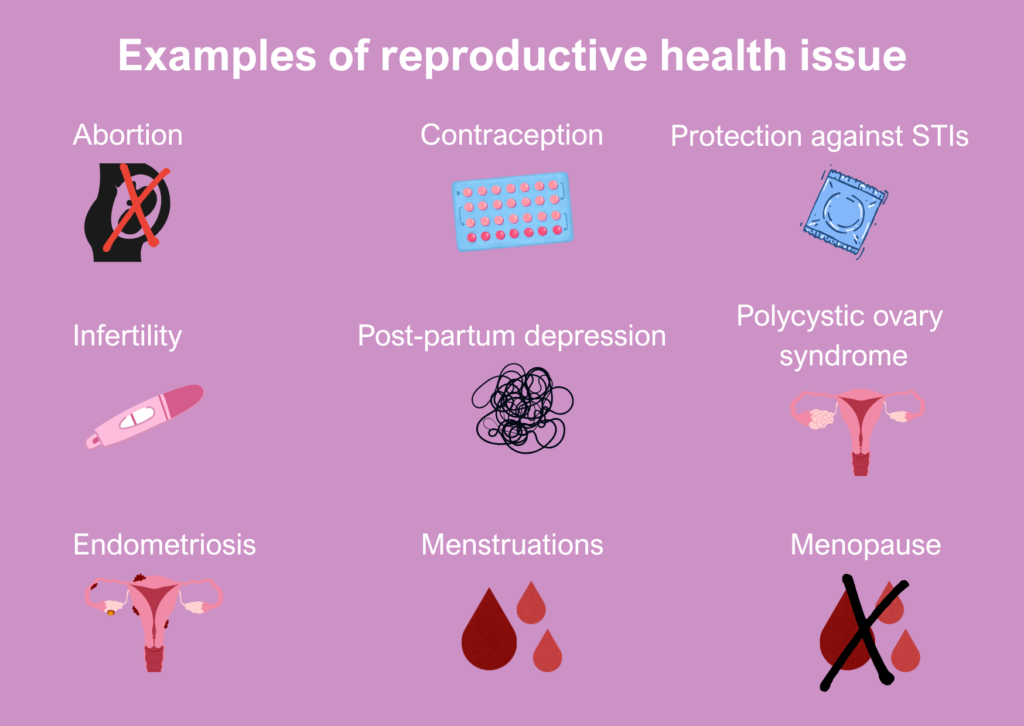
Reproductive health is defined by the European Institute for Gender Equality as a state of complete physical, mental and social well-being, not merely the absence of disease or infirmity, in all matters relating to the reproductive system and to its functions and processes. It implies that people are able to have a satisfying and safe sexual life and that they have the capacity and the freedom to decide if and when to have children. Reproductive health concerns both women and men. However, women usually wear physical and mental burden of contraception, pregnancy, abortion, and fertility treatments. Menstruations and menopause are also essential components of reproductive health. Yet, many conditions and diseases in the realm of reproductive health are still considered a taboo and, in some cases, simply part of being a woman. This leads to pain and symptoms being sometimes dismissed by patients themselves and medical professionals.
Women’s health has long been associated with reproductive health, due to reproduction being considered for centuries as the sole purpose and source of value of women. Thankfully, this vision has evolved. But stigma and taboos are still present in societies across the world.
Reproductive health is considered a component of reproductive rights. Member States are still divided on some topics, such as abortion, which has led the issue of reproductive health being removed from the portfolio of the Hungarian Commissioner for Public Health and Animal Welfare Oliver Varheyli to be given to the Belgian Commissioner for Equality, Preparedness, and Crisis Management Hadja Lahbib in 2024.
Reproductive health and gender-specific conditions are increasingly present on the European agenda. On 5th March, the European Commission published it’s Gender Equality Strategy 2026-2030. The document announced the launch a study on the economic and societal benefits of closing the women’s health gap related to certain conditions, such as menopause in 2028. The Commission will also organise an exchange of best practices regarding menstrual and menopause poverty at the national level.
The European Parliament’s Committee on Women’s Rights and Gender Equality is currently drafting a report intitled “Gender inequalities in health, specifically as regards gender-specific conditions” which is foreseen to be adopted by the Parliament in July. The draft report mentions reproductive health issues such as abortion, endometriosis and menopause. Ongoing amendments aim to expand the report and include further topics such as contraception, menstrual health and infertility.
Covering each disease and condition related to reproductive health is impossible in a single article. We will focus on several topics that have emerged on the European agenda due to lobbying from patient groups, medical professional associations and industry:
Menopause
On 24th March, the European Parliament held a hearing dedicated to menopause. As it was highlighted by the co-chair MEP Romana Jerkovic, this was the first time that the Parliament debated on this topic. Even though menopause will affect all women (so half of the population) it is still a taboo and not integrated enough into medical and pharmaceutical curricula. A study commissioned by the European Parliament showed that 85 % of women experience menopause symptoms such as insomnia, anxiety, memory loss or hot flushes. This condition doesn’t only impact the quality of life of women; it also bears health implications. As an example, menopause significantly increases the risk of cardiovascular diseases due to a decline in estrogen (a hormone). Menopause also negatively affects women’s livelihood, indeed, a study by Professor Gabriella Conti shows women experience a 4.3% drop in earnings within four years of a menopause diagnosis which increases to 10% by the fourth year. As mentioned previously, the Commission is foreseeing actions on menopause and the Parliament’s report is mentioning it extensively. Yet, the road to better understand and break the taboo around this condition and treat symptoms has just started.
Endometrosis
Endometriosis is a chronic inflammatory disease where cells similar to the ones in the lining of the uterus are found elsewhere in the body and are affected by the monthly cycle of hormonal changes. This can cause inflammation, pain and scar tissue. Overlooked and under researched for decades, it is estimated to affect at least 1 in 10 women. Due to this lack of knowledge, it takes on average 6 to 10 years to diagnose. Endometriosis’ symptoms can be extremely painful and incapacitating with serious consequences on the patient’s psychological health. This disease also carries a significant economic burden: the annual cost of sick leave due to endometriosis in the EU in 2023 was as high as €30 billion. Endometriosis has been one of the flagship diseases in the public debate on women’s health, with awareness of the disease increasing in recent years. As a consequence, the European Commission has allocated EU funding to several projects on endometriosis research through the Horizon Europe Programme. But the scope of this funding is limited: only 10 of the 145 983 EU-funded projects in the last 40 years, have focused specifically on endometriosis, a daunting figure acknowledged by the European Parliament’s draft report. Endometriosis, sometimes referred to as the “missed disease” is a prime example of how awareness raising, a core task of our consultancy, can influence EU funding decisions, which highlights the role of continued advocacy towards policymakers.
Menstrual health
Menstrual health, which like menopause concerns all women, has also been a taboo topic for a long time. Now, thankfully, mentalities are changing and this issue has been more present in the public debate in the last 10 years. Yet, change is slow. The public debate around menstruations has tended to focus on two topics: the establishment of menstrual leave and menstrual poverty.
In 2023, Spain became the first and only country in Europe to introduce paid menstrual leave allowing employees who suffer from severe menstrual pain to take three to five days of state-funded paid leave per month. Nearly 3 years after the law passed, The Guardian reported a low uptake of the leave, writing that menstrual leave had only been taken 1,559 times fin one year. Two reasons have been advanced to explain this figure: first, only employees with a medical diagnosis can take menstrual leave and second, employees may be reluctant to take menstrual leave due to a fear of discrimination or retaliation for taking this “additional” leave. This is a controversial policy, which relies solely in the hands of the Member States, but the European Commission can provide recommendations and facilitate the exchange of best practices on menstrual leave.
Menstrual poverty, defined as insufficient access to menstrual hygiene products and facilities, affects an estimated 1 in 10 of women in the EU. This was the topic of a hearing in the European Parliament in May 2025. To make period more affordable, in 2022, the EU revised its VAT Directive to allow Member States to apply reduced or zero VAT rates to menstrual products, shifting their classification from luxury to essential goods. Some countries (Ireland, Cyprus and Malta) have adopted a zero rate, while others (Hungary, Sweden and Denmark) maintained standard rates. In rare cases, menstrual products are free. As an example, France offers free, organic products in universities and high schools. Catalonia offers free reusable menstrual products in pharmacies since 2024.
An issue that has been absent from the public debate is Premenstrual Syndrome (PMS) and period pain, despite the fact that that 90% of women experience PMS symptoms. While gynaecologists say mild to moderate period pain is common and normal, severe pain that disrupts daily life, requires staying home, or does not improve with medication is not normal. PMS management represents a large unmet need, but research remains chronically underfunded. Beyond painkillers and antispasmodic medications, some innovations such as medical devices using TENS technology have been clinically validated and brought to the market. But these devices are not devoid of issues (lack of discretion, cost).
Abortion
Abortion is legal is most EU Member States, although it is largely criminalized in Malta and Poland. Yet, beyond legal status, performance on safe abortion, notably with regard to access, varies strongly by country. This leads to high inequalities between Member States, which sparked, in 2024, the launch of the European Citizens Initiative My Voice My Choice. This petition demanded that the EU creates a financial mechanism that helps Member States (on a voluntarily basis) to provide safe abortion care for women who don’t have access to it. A European woman could travel to any EU country to get an abortion with her travel and procedure costs covered by this EU fund. The ECI gathered 1,12 million signatures, above the 1 million thresholds required for such petitions. In February 2026, the European Commission formally answered: it refused to create a new financial instrument, saying that Member States can already rely on the European Social Fund Plus programme to do so. This answer was seen as a political endorsement by the ECI’s organisers, but it falls short of creating earmarked funding for abortion access.
Contraception
Contraceptives (pills, condoms, IUDs) are all approved by the European Medicine Agency or regulated under the Medical Devices Regulation. Yet, awareness of women experiencing significant side effects of hormonal contraceptives (pills, IUDs, patches and implants) is rising. Contraceptives suffer from a dire lack of innovation since the creation of the birth control pill. The EU has not funded the development of novel contraceptives since 2021. While the contraceptive burden is disproportionally carried by women, male contraceptives have known no real advances, due to lack of funding for clinical trials and a lack of clear regulatory guidelines from the European Medicines Agency. An alarming decline in condom use among sexually active adolescents exacerbates even more the weight of contraception on young women.
Furthermore, access to contraceptive is uneven across EU countries. Coverage is a national competence, which significantly affects the affordability or unaffordability of contraceptives. It must also be stressed that in committed relationships, while both partners benefit from the use of contraception, the costs are often largely or entirely born by the woman as shown by a recent study from the University of Amsterdam. Beyond the cost of contraception, sometimes the physical availability of some contraceptives is challenged, with episodic shortages occuring. As an example, at the time of writing this article, Spain reports a shortage of Ulipristal Aristo, an emergency contraceptive. This led several MEPs to push for the inclusion of contraceptive and abortion-related medicines in the Critical Medicines Act. But this may not survive negotiations with Member States, due to the opposition of some countries, including Poland and Hungary.
Infertility
Globally, 1 out of 6 people face infertility. That translates to about 25 million people in the EU. Women are disproportionately affected by both the social stigma and the physical burden of treatments. As usual, access to fertility treatments is unequal across the Union. As an example, only 9 out of the 27 EU countries offer full funding for up to six In Vitro Fertilization treatments. After six treatments, Austria, Denmark, Estonia, and France are the only countries where partial reimbursement is available. While infertility diagnosis, counselling and treatment is a Member State competence, the EU can improve education and awareness on infertility, inform about lifestyle factors and reduce social stigma and disinformation.
Conclusion
The stark inequalities and gaps regarding reproductive health prove that Europe needs a dedicated Strategy on reproductive health and gender specific conditions, build on the model of the Beating Cancer Plan adopted in 2021 and the Safe Hearts Plan adopted in 2025. For too long, issues that affect women’s reproductive organs have been taboo and women have been told that suffering is part of a woman’s life. Such a Strategy needs dedicated funding, notably for therapy development and access. That is also necessary for medical devices that often do not fit the needs and bodies of women. A blatant symbol is the speculum, a device that has stayed nearly the same since its invention in 1845. A project to create a woman-friendly speculum is ongoing in Netherlands led by Ariadna Izcara Gual and Tamara Hoveling at TU Delft (without EU funding). Such a discussion is even more important as the EU budget for the next 7 years is currently being negotiated. A lot of European start-ups and SMEs are creating innovative solutions, in a growing sector named “FemTech”, it is important that EU funds support these companies in bringing their products to the market, so that they effectively reach patients. When we analysed the calls for project in the 2025 EU4Health Programme, only one call (on safety of breast implants) was dedicated to women’s health. Women represent half of the EU’s population; it is time that it’s public funding reflects this fact. If your company develops a product to advance reproductive health, Lykke Advice can help you gain visibility, influence policymaking and funding to make reproductive health a reality in all of Europe.
