


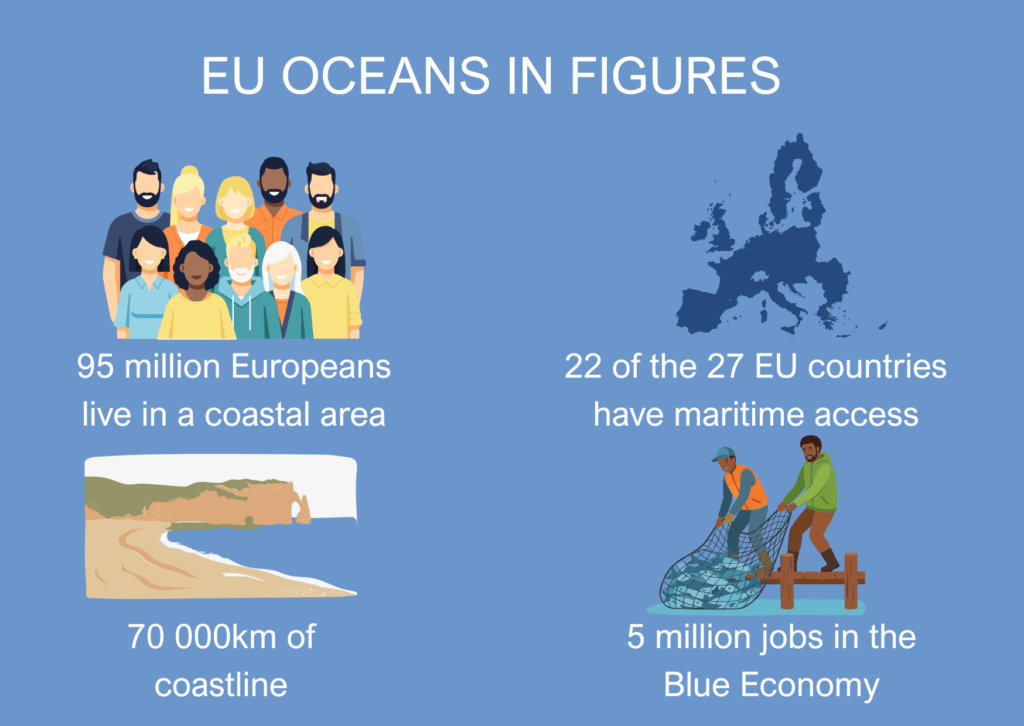
Oceans and seas are, like forests, the blue lung of Europe. They are also a key area for the EU’s economy and competitiveness, with 74% of the EU’s external trade done by maritime transport. Uses of oceans and seas vary greatly and can sometimes compete, such as fishing, shipping, energy production or tourism. The Commission is expected to publish, by the end of 2026, an Ocean Act to improve maritime governance. This Directive is at the right time for many companies in the blue economy to ensure this new legislation supports their business. This article will dive into the opportunities offered by the Ocean Act for several sectors.
The Ocean Act, the continuation of the Ocean Pact
Adopted in June 2025, the Ocean Pact is a non-binding document, a strategy to better protect the ocean, promote a thriving blue economy and support the well-being of people living in coastal areas. The Ocean Pact is built around six priorities:
- Protecting and restoring ocean health
- Boosting the competitiveness of the EU sustainable blue economy
- Supporting coastal and island communities, and outermost regions
- Advancing ocean research, knowledge, skills and innovation
- Enhancing maritime security and defence
- Strengthening EU ocean diplomacy and international ocean governance
The Ocean Act, scheduled for Q4 2026, is one of the flagship actions of the Ocean Pact. It will be in the form of a Directive, therefore legally binding, and will build on the revision of the 2014 Maritime Spatial Planning, MSP, Directive. This MSP Directive supports efficient marine resources management and sustainable development. It is a procedural framework obliging Member States to draw up maritime spatial plans which map, accommodate and reconcile each sector’s spatial use of the sea.
The Ocean Act is expected to bring a “multi-use by design” approach to tackle spatial squeeze in certain maritime areas. In addition, it will serve as the legal foundation for the Ocean Observation Initiative, which aims to create a European observation system providing critical data for weather forecasting, climate change mitigation and adaptation, extreme events monitoring, civil security, sea conditions, etc.
The Ocean Act will impact many sectors such as fisheries and aquaculture, shipping and ports, offshore energy, recreation and tourism, marine biotechnology and telecom. We will discuss the opportunities and challenges for each sector in the following sections.
Fisheries and Aquaculture
The European fisheries and aquaculture sectors contribute about €5.5 billion per year to the EU economy and provide direct employment to around 193,000 fishers and aquaculture farmers across Europe. The sustainable development of fisheries and aquaculture is a mandatory objective of maritime spatial planning under the current MSP Directive.
While they are mostly regulated by the Common Fisheries Policy, the Ocean Act provides opportunities for the fisheries and aquaculture sectors by enabling more predictable spatial access. The Commission recognised access to marine space as an important constraint on sustainable aquaculture growth and identified licensing processes as a key bottleneck. A clearer sea-basin approach should ease the licensing and siting bottlenecks that hold back the development of aquaculture.
However, the Ocean Act is being designed to align with the Marine Strategy Framework Directive, the EU’s law requiring “good environmental status” of marine waters. For aquaculture, this could mean that easier access to marine space comes with stricter environmental requirements.
Shipping and Ports
EU ports handle 3.4 billion tonnes of goods per year, making them powerhouses of the EU’s internal and external trade. The sustainable development of maritime transport is also a mandatory objective of the MSP Directive. Recently, maritime transport and ports have received a lot of attention at the EU level with the publication in March 2026 of the EU Industrial Maritime Strategy and the EU Ports Strategy. Moreover, these sectors are regulated by the 2017 Port Services Regulation, the 2023 FuelEU Maritime Regulation and the 2023 EU ETS Maritime Directive.
More coordinated maritime spatial planning in the Ocean Act would give ports and shipping operators greater certainty over the use of maritime space, helping facilitate new infrastructure, shipping routes and other projects. The Ocean Act also brings opportunities to invest in greening these sectors by boosting the uptake of electrification, alternative fuels, climate resilience and other clean maritime technologies.
Yet challenges will likely remain as maritime transport will have to increasingly compete with environmental protection and offshore renewable-energy deployment in limited sea space.
Offshore energy
European countries are among the most important markets for offshore wind energy, with a cumulative offshore wind energy capacity of 37 gigawatts, roughly 45% of total offshore capacity worldwide. The EU offshore wind energy sector is one of the fastest growing sectors in the EU economy.
Offshore energy, both hydrocarbons and renewables, is also covered as a mandatory objective in the MSP Directive. The EU offshore energy framework is primarily shaped by the 2022 TEN-E Regulation, currently under revision, which supports offshore grids, interconnectors and renewable energy integration, and the 2013 Offshore Safety Directive, which sets the main safety and environmental requirements for offshore oil and gas operations.
The Ocean Act will likely facilitate the deployment of offshore wind, ocean energy, including wave, tidal and thermal energy, electricity interconnectors and other strategic energy infrastructure by improving cross-border coordination and increasing legal certainty for investors. For non-renewable offshore energy, the Ocean Act is likely to bring greater regulatory scrutiny and stronger environmental constraints, potentially restricting developments in environmentally sensitive areas.
Recreation and tourism
Coastal tourism is the largest blue economy sector, generating 33% of the EU blue economy’s Gross Value Added and 53% of total EU blue economy employment. Despite this, tourism is only mentioned as an optional objective of maritime spatial planning under the MSP Directive because tourism is primarily a national competence.
Nevertheless, the 2025 Ocean Pact announced the publication of an EU Sustainable Tourism Strategy in spring 2026, but the Strategy has not yet been published.
The Ocean Act could create important opportunities for the tourism and recreation sector through support for sustainable coastal and maritime tourism, improving the environmental quality of coastal destinations and providing more coordinated maritime spatial planning for activities such as boating, diving, sailing and recreational services. Yet, it could also restrict certain tourism or recreational activities in sensitive areas.
Marine biotechnology
Marine biotechnology relies on biological material sourced from marine organisms, such as algae, cyanobacteria, fishery by-products and microorganisms, and spans multiple industries and applications, including pharmaceuticals, cosmetics, feed ingredients, biomaterials and chemicals. As a relatively new, yet growing, sector, it is not mentioned in the MSP Directive, which only cites scientific research as an optional objective.
The Ocean Act could boost investments in R&D relevant to marine biotechnology. Indeed, the 2025 European Ocean Pact dedicates one pillar to ocean research, knowledge and innovation, which could help accelerate the commercialisation of marine-based technologies.
For the marine biotechnology sector, the main challenge will be ensuring that the exploitation of marine biological resources remains compatible with biodiversity protection and ecosystem-restoration objectives. Stronger environmental safeguards and expanded marine protected areas could constrain bioprospecting or increase compliance and permitting requirements.
Telecom
With 99% of global internet traffic carried by underwater cable, the Ocean Act will impact the telecom sector. Yet, the MSP Directive merely lists “submarine cable and pipeline routes” as a planning category.
Internet traffic carried through submarine cables is mainly regulated by the 2022 NIS2 Directive, which addresses cybersecurity and network resilience, the 2022 Critical Entities Resilience Directive, which strengthens the physical protection of critical infrastructure, and the 2018 European Electronic Communications Code, which provides the broader regulatory framework for telecom networks.
Submarine cables are mentioned in the 2025 Ocean Pact as critical maritime infrastructure. The Pact focuses on the implementation of the 2025 EU Action Plan on Cable Security. The Plan establishes, with voluntary participation of Member States, an Integrated Surveillance Mechanism for Submarine Cables per sea basin, designed to link and combine data from relevant sources and establish an accurate, real-time sea-basin situational picture. This mechanism will start with the Baltic Sea.
The Ocean Act could make it easier for the telecom sector to plan new cable routes and avoid conflicts with offshore energy or protected areas by improving maritime spatial planning and coordination. The Ocean Act is also expected to enhance submarine cable security by helping operators protect subsea data and communication cables given their status as critical infrastructure.
How to influence the Ocean Act?
Right now, the Commission’s proposal for the Ocean Act still needs to be published. The Commission opened a call for evidence from January to February 2026 and a public consultation from April to July 2026. This means that the text is still being drafted by the Commission’s Directorate-General for Maritime Affairs and Fisheries. Lykke Advice can put your company or organisation in contact with the relevant unit of the Commission that is analysing the answers to the public consultation and refining the proposal’s text.
In 2027, once it is proposed, the Ocean Act will move into the ordinary legislative procedure and the Council of the EU, representing the Member States, and the European Parliament will each draft their own position on the Directive. In this second phase, it will be important to reach out to Member State attachés in Brussels and key MEPs to influence each version.
In a third phase, the Commission, Council and Parliament will enter into negotiations and agree on the final version of the Ocean Act. This is why it is important to have the three versions as aligned as possible to ensure your priority points make it into the final text. This last stage will likely happen in late 2027 or early 2028.
As an EU public affairs consultancy, Lykke Advice can help you navigate the legislative process, identify key stakeholders and shape your messages to ensure your company or organisation’s interests are represented. If this sounds interesting, contact us at info@lykkeadvice.eu.
