


On 16 July 2025, the European Commission launched its most ambitious long-term spending plan to date, an almost €2 trillion budget for 2028–2034, promising to be simpler, more flexible, and more strategic than any before it.
For European SMEs, this new Multiannual Financial Framework (MFF) could unlock a wave of targeted support. But the road ahead is complex: it is paved with streamlined yet untested structures, novel funding sources, and a politically charged negotiation landscape.
The aim of this opinion piece is to provide a small yet explicit guide to the main aims of the Commission’s proposals for the next multiannual budget, the challenges and opportunities for European SMEs, and the main beneficiaries of much of the direct and indirect funding that the EU will provide in the coming years.
The MFF in the Treaty
According to Article 312 of the Treaty on the Functioning of the European Union, the MFF shall ensure that Union expenditure develops in an orderly manner and within the limits of its own resources. Adopted by the Council of the EU and with the consent of the European Parliament, the MFF lays down the framework for EU expenditure over a seven-year period. Every year, within the precise boundaries set by the MFF, the Commission presents a yearly budget for the EU that must be approved by Parliament after the Council has given its position.
For this reason, the MFF proposal and decision are a significant moment in the EU, as they set out the boundaries and limits of EU spending capacity for the next seven years. While revisions to the MFF are possible, they remain limited to exceptional cases such as the recession of a Member State or the accession of new ones.
Given its limited size, normally around 1% of EU total GDP, the main goal of the EU budget is to provide investments in EU-wide areas and public goods, while strategically subsidising weaker sectors of the EU economy. This is why the seven-year length is the best compromise: it is designed to balance the predictability needed for investments with the flexibility required for expenses, as emergencies may arise from year to year. On this point, the exercise has become ever trickier in recent years as Europe has passed through an unprecedented pandemic and economic crisis, followed by energy and defence security challenges. For these reasons, as Europe’s priorities in a changing world are shifting, the next MFF’s task is even more difficult than before: facing increased demand for spending in more sectors with the same, or slightly increased, resources available, besides having to repay the NGEU debt.
New political priorities
The new proposal for the MFF is not merely a financial exercise; it is a reflection of Europe’s shifting political agenda. Where the previous cycle was built around the Green Deal, the Commission now signals a turn toward a “Clean Industrial Deal”, linking climate ambition to industrial competitiveness. The Draghi Report has propelled competitiveness to the top of the Union’s priorities, while defence spending, technological leadership, skills, innovation and scale-up have gained unprecedented prominence. Sustainability remains crucial, but it now shares the stage with these other priorities. The real challenge of the next MFF will be to combine them effectively and ensure that no key priority is left behind.
A new structure
Echoing the general simplification trend, the Commission has decided to consolidate the more than 540 existing programmes into 27 National and Regional Partnership Plans (NRPPs), simplifying access and aligning support with specific regional needs, and therefore giving more power back to Member States in spending decisions.
The Commission’s proposal of a €1.984 trillion budget for the 2028–2034 period signals a small increase in the EU budget size. However, it is in the structure that the biggest shift from the past lies. The Commission is proposing a new budget based on four strategic funding pillars to finance Europe’s priorities.
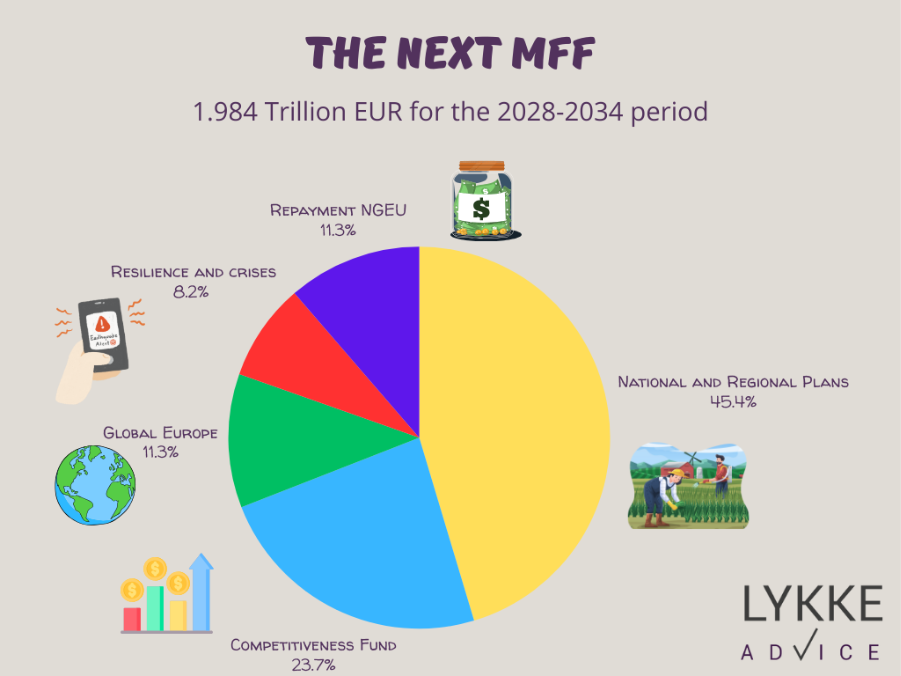
- Investing in people, Member States and Regions
The core proposal of this pillar is the National and Regional Partnership Plans (NRPPs) with a total allocated funding of €865 billion, which will be the foundation of investment and reforms. The absolute novelty of these plans is the merging into a single instrument of the two historically largest spending areas of the EU budget: the Common Agricultural Policy and the Cohesion Policy.
The main aim of these strategic plans will be to tailor the funding to the specific needs of Member States and regions while maintaining coherence with EU priorities. They will bring together 14 existing funds and ensure coherence between them. In this context, the Common Agricultural Policy is allocated roughly the same amount as seven years before, namely €300 billion, while €218 billion is destined for the Cohesion Policy.
Additionally, Member States will be able to invest in European priorities via EU-backed loans under the new Catalyst Europe facility. These loans, supported by the EU budget, will empower countries to invest in areas like defence, energy, and technology.
- Competitive and Innovative Europe
As announced following months of debate after the publication of the Draghi Report, the European Commission has decided to include a Competitiveness Fund of €409 billion in the new multiannual budget. This fund, working in synergy with Horizon Europe, will provide seamless support to European innovators from research to deployment, from ideas to start-up to scale-up. It will power the implementation of the Competitiveness Compass and help the Union build a competitive edge in strategic sectors, including multi-country and cross-border projects with high EU value added. In this way, it will drive prosperity and the creation of high-quality jobs.
As set out by the Clean Industrial Deal as well as in the Letta and Draghi reports, the overarching goal of the fund will have to be to combine effectively the decarbonisation of Europe’s economy with economic growth, through affordable energy prices, the support and scale-up of made-in-Europe clean products and technologies (also via the Industrial Decarbonisation Accelerator Act), high-skilled jobs, and strengthened finance for scaling up clean tech projects.
Europe is not only a laboratory of clean technologies, it must also become their most dynamic exporter. Today, the EU generates more than 27% of global clean-tech patents, outpacing the US, Japan, and China, and has already become a net exporter in several clean-tech sectors. But Europe’s strength goes far beyond wind turbines and heat pumps. From advanced water technologies and circular bioeconomy solutions to sustainable agriculture, green materials, and smart energy systems, European innovators are setting global standards. The future Competitiveness Fund must therefore make it a strategic mission to turn Europe into the world’s main hub for exporting this full spectrum of green innovation.
Commissioner for Budget Piotr Serafin has made clear on many occasions that the aim of the new budget must be to do at the European level what can be done best, namely, investment in EU public goods as a way also to crowd in more private capital. The Competitiveness Fund is therefore supposed to support critical areas for EU competitiveness, such as the clean transition, digital leadership, resilience and cybersecurity, the defence industry and space, health, biotech, agriculture, and the bioeconomy.
Crucially, it will be up to InvestEU to leverage public and private partnerships towards the EU’s top priority sectors, also working in close coordination with the European Investment Bank and the national promotional banks. Yet, to achieve full mobilisation of private capital, the completion of the European Capital Markets Union remains an absolute priority, and Europe must take significant steps before the adoption of the new budget if it wants to reach the goal of more capital investment. This was indeed one of Europe’s key weaknesses highlighted by the Draghi Report, and Europe is still lagging in this respect compared to the United States and other global players.
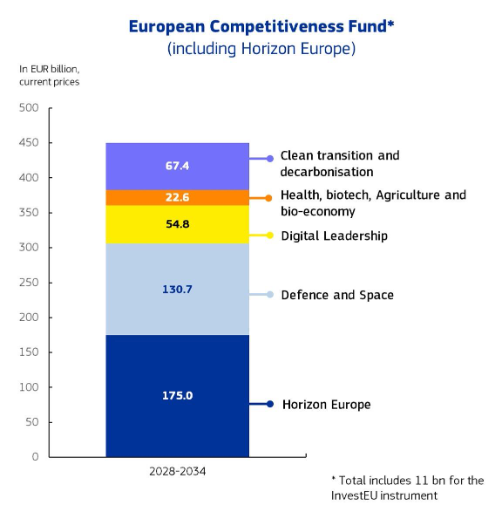
Credits: European Commission
A quick look at the graphic reveals a striking increase in the funds allocated for defence in the next decades. If the White Paper on European Defence and the Readiness 2030 package, together with the unprecedented €150 billion provided by the SAFE instrument to assist Ukraine and Member States in speeding up defence readiness, had set out the general framework for defence investment for decades to come, it is now up to the next budget and funds to support Member States in embarking on the journey towards “a new era of strategic investments” in European defence capabilities and readiness. That is why the Competitiveness Fund will aim to substantially increase financing compared to the current framework. This will signal a tenfold increase in funds allocated to military mobility and a fivefold increase for defence and space, representing an unprecedented opportunity for European SMEs active in the fields of defence and dual-use technologies. As announced, further support will also be given to the Projects of Common European Interest (PCEIs) under the regional and partnership plans.
The Global Europe Instrument
A new €200 billion fund for Global Europe has also been proposed by the Commission. If confirmed, that will represent a 75% increase compared to the previous budget to finance Europe’s growing responsibilities on the world stage. This new fund will consolidate the Global Gateway and strategic partnership projects into a single instrument. Enlargement will play the greatest part, opening the full Global Europe toolbox to candidate countries to support reforms and investments.
An additional €100 billion is also expected to replenish the already existing Ukraine Fund to drive reconstruction and support efforts.
Europe’s resilience and preparedness
Drawing inspiration from former Finnish Prime Minister Niinistö’s report, the Commission has proposed a dedicated crisis mechanism with a potential €400 billion capacity to allow Europe to respond to and withstand emergencies and disasters it may face in the years to come. While they do not represent a chapter of fixed expenditure, these funds constitute a reserve to be activated in cases of unforeseen crises, instead of simply relying on Article 122 of the TFEU to finance unprecedented emergencies.
The Commission has also proposed to increase funding in the preparedness area fivefold, to €10.7 billion, to face the challenges presented by climate change, health, and security.
Simplification and new own resources
The overall logic behind the simplification effort in the new budget is clear: achieve more coordination in financing, grant easier access, avoid overlapping programmes, and strengthen the single market in order to generate more spillovers. Indeed, one of the key recommendations of the Letta Report on generating more spillovers lays down a simple macroeconomic concept: more coordinated investments in specific sectoral areas lead to efficient cross-border spillovers and deeper integration of the common European market.
As Member States are unwilling to increase their national contributions to the EU budget, while the amount of money needed to cover all these priorities is much larger, the Commission’s proposal introduces five new revenue streams designed to repay the debt of NextGenerationEU while reducing the pressure on national contributions.
These include a share of revenues from the EU’s Emissions Trading System and the Carbon Border Adjustment Mechanism, alongside innovative levies on non-collected e-waste and tobacco products. Most significantly, a new “Corporate Resource for Europe” would require large companies with turnovers above €100 million to make a lump-sum contribution, while exempting SMEs. Together, these measures could mobilise more than €40 billion annually, creating fiscal space to fund Europe’s priorities, from competitiveness to defence, without overburdening Member States. If adopted, this diversified resource base would mark a decisive step toward greater EU financial autonomy and resilience.
The RRF model and the shift towards results-based financing
One of the most interesting aspects of the proposed new MFF is the emphasis placed by the Commission on the results-based model of funding. Whereas current funding (especially for Cohesion and Agricultural Policy) was input-based (money was allocated when Member States followed procedural rules and reported eligible costs), the new system is inspired by the Recovery and Resilience Facility model. Under the new framework, funds will be allocated under the strategic and regional partnership programmes only when pre-agreed milestones and targets are achieved. These milestones will be measurable, linked to EU priorities, and will drive the entire process of fund granting.
Conclusion: opportunities in sight for SMEs
The proposed framework introduces instruments that directly respond to the structural weaknesses SMEs face in Europe: fragmented markets, limited access to finance, and regulatory burdens.
The new Competitiveness Fund is a game-changer: it will replace overlapping programmes with a single rulebook, simplified procedures, and fast-tracked disbursements. This means SMEs will gain easier and quicker access to EU support for scaling up, deploying innovation, and entering cross-border markets. Crucially, the fund will channel resources into strategic sectors such as clean technologies, digital leadership, biotech, agriculture, and the bioeconomy, all areas where SMEs are at the forefront of innovation. Combined with InvestEU’s leveraging effect, the fund can crowd in private investment, making it easier for SMEs to attract capital and participate in Important Projects of Common European Interest (IPCEIs).
For SMEs, the stakes of the upcoming budget talks are high. The National and Regional Partnership Plans, which will govern €865 billion of investments, promise tailored support for local needs and reforms. If SMEs actively shape these plans, they can secure targeted measures on skills, digitalisation, sustainability, and internationalisation. Moreover, the move towards results-based financing means that only well-defined priorities with measurable impact will be funded. Without strong SME engagement, there is a risk that large corporates or national interests dominate the agenda.
By advocating for simpler access conditions, SME-friendly financing instruments, and support for participation in global supply chains, Europe’s smaller firms can ensure they benefit from the MFF’s ambition to make Europe the world’s hub for clean, digital, and resilient industries.
As a boutique Public Affairs consultancy, Lykke Advice can help your SME navigating the complex EU landscape in Brussels by shaping legislation and monitoring the recent developments to always make sure your business can seize the most relevant opportunities. As negotiations for the next MFF begins, Lykke Advice can help you getting traction and future funds at EU level.
