

As one of the founding fathers of the European Union, Jean Monnet, once said: “Europe will be built through crises, and it will be the sum of the solutions adopted for those crises.” These words resonate now more than ever, as Europe faces one of the most profound existential challenges since its inception.
The Russian aggression against Ukraine in February 2022 served as a brutal wake-up call. After the end of the Cold War and the rise of what many believed to be a stable, US-led global order, Europe gradually diverted its attention and resources away from defence. Undoubtfully, the circumstances weren’t helpful as Europe has to focus on recovering from successive economic shocks: first the 2008 financial crisis, then the sovereign debt crisis in 2011, both of which called into question the future of the European project itself. More recently, the COVID-19 pandemic pushed the EU into an unprecedented public health and economic emergency.
Just as recovery seemed within reach, war returned to the European continent, reminding us that peace can never be taken for granted. And now, with rising geopolitical tensions, the need for Europe to take responsibility for its own security has become urgent.
In October 2024, former Finnish President Sauli Niinistö presented a comprehensive report on strengthening Europe’s civilian and military preparedness. In his recommendations, he stressed the urgent need for the EU and its Member States to develop the capacity to anticipate, prevent, withstand, and respond to major shocks with cross-border and cross-sectoral impacts. Among his proposals, Niinistö called for dedicating at least 20% of the EU budget to security and crisis preparedness, an ambitious target aimed at ensuring the Union is equipped to manage threats ranging from military aggression and cyberattacks to climate-induced disasters.
Just a month earlier, the Draghi Report had painted an equally alarming picture. It revealed that approximately 80% of EU defence procurement currently comes from outside the Union, with 63% sourced from the United States. This heavy reliance on external suppliers severely undermines the EU’s strategic autonomy. In response, Draghi proposed the creation of a centralised EU Defence Industry Authority to coordinate acquisitions, pool demand, and stimulate industrial capacity within Europe.
Rearm Europe
The urgency of these reforms has only grown with recent geopolitical developments. The return of Donald Trump to the White House and the resurgence of an “America First” doctrine have reignited doubts about the long-term reliability of U.S. commitments to NATO and European security. This geopolitical shock has forced the EU to accelerate its defence ambitions, culminating in the unveiling of the “Rearm Europe” initiative, a bold step toward building a more sovereign and resilient European security framework.
The ReArm Europe Plan – Readiness 2030 outlines a comprehensive strategy to significantly strengthen the EU’s defence capabilities. With both legal and financial tools, the plan provides immediate levers for Member States to ramp up defence investment and readiness in response to an increasingly unstable geopolitical environment.
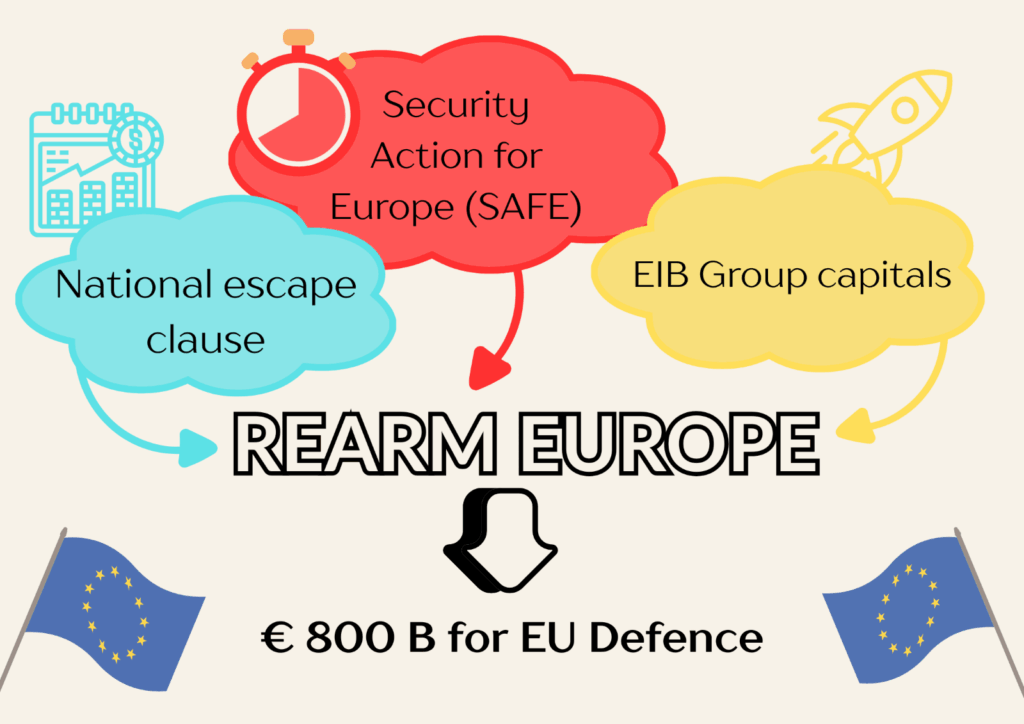
Structured around three main pillars, the plan aims to mobilise up to €800 billion in defence investment trough:
- Unlocking national fiscal space: the first pillar allows Member States to increase defence spending by activating the national escape clause under the Stability and Growth Pact. This exceptional measure enables temporary deviation from the EU’s strict fiscal rules, such as the 3% annual deficit ceiling and debt reduction targets, by exempting defence-related expenditure from these calculations. The European Commission expects this flexibility to create up to €650 billion in fiscal space over four years, supporting an average 1.5% GDP increase in national defence budgets.
- Establishing SAFE – Security Action for Europe: the second pillar introduces a new instrument: SAFE, a €150 billion loan facility designed to finance urgent and large-scale defence investments through joint procurement. Funds will be raised on the capital markets and made available to Member States based on national investment plans. This initiative aims to encourage collective procurement, spending better, together, and in Europe.
- Mobilising private capital and leveraging the EIB Group: the third pillar focuses on attracting private investment into the European defence sector. By accelerating savings and investment flows and leveraging the financial capacities of the European Investment Bank Group, the plan seeks to reduce reliance on public funds and increase the involvement of private actors in defence manufacturing, infrastructure, and innovation. This creates unique opportunities for SMEs and defence companies across Europe, making market access more viable and investment less risky.
Yet, unlocking this financial potential is not enough. A fully functioning European defence single market is essential to ensure these investments are used efficiently. As acknowledged in the mission letter of the new Commissioner for Defence and Space, Andrius Kubilius, the fragmentation of the EU’s defence landscape remains a major barrier. True integration will require consolidating supply chains, foster industrial cooperation, and shift from a logic of national competition to one of strategic partnership.
Towards a Truly Integrated European Defence: A Strategic Imperative
Despite recent progress through initiatives such as EDIRPA (European Defence Industry Reinforcement through Common Procurement Act) and ASAP (Act in Support of Ammunition Production), the EU continues to fall short of establishing a truly integrated and resilient defence system. These instruments have played a crucial role in promoting joint procurement and replenishing critical stockpiles, with the broader aim of enhancing interoperability among Member States. However, while their objectives are laudable, they remain insufficient in scope and permanence to fully align the EU’s defence posture with today’s rapidly evolving security landscape.
Instruments like EDIRPA should not be temporary crisis-response tools but rather permanent, structural pillars of EU defence policy. Greater emphasis must be placed on long-term cooperative projects where Member States jointly invest in capabilities, co-develop critical systems, and collectively contribute to strategic autonomy. The ultimate goal must be a European defence system that is not merely reactive but strategically proactive and sustainable.
At a time when geopolitical uncertainties are mounting, particularly in light of potential new tariffs under a future Trump administration, the EU must resist the temptation to revert to transatlantic procurement to avoid tariffs, as recently voiced in the media. While strong transatlantic ties remain essential, Europe must avoid becoming dependent on external suppliers. Doing so would undermine years of progress towards strategic autonomy and compromise the EU’s credibility as a defence actor. Instead, Europe should aim to strengthen its own defence capabilities, not in opposition to NATO or the United States, but as a capable and reliable partner that does not outsource its security responsibilities.
A shift in the narrative and the White Paper on the Future of European Defence
The debate on a European defence identity has been one of the most enduring in the history of European integration. Ultimately, the issue is not one of funding alone, but of political will. Even in a context of unprecedented financial support, the true challenge lies in the reluctance of some Member States to move beyond the perception of defence as an exclusively national competence.
The appointment of Andrius Kubilius as the first-ever European Commissioner for Defence and Space marks a significant moment of awareness for the European Union. Such a position would have been unthinkable in the previous Commission term, but the evolving global security landscape has made it a necessity. This strategic move was a key commitment in Ursula von der Leyen’s re-election campaign: she pledged that, if reappointed as President of the Commission, her new team would include a dedicated Defence Commissioner, and she delivered.
This appointment is part of the EU’s broader political response to the complex global situation. It reflects a growing recognition that advancing towards a common defence policy requires a Commissioner capable of coordinating cooperation and laying the groundwork for a more integrated and effective European defence framework.
Additionally, as part of the European Union’s growing political ambition in the field of defence, a significant development was the upgrade of the SEDE Subcommittee on Security and Defence to a fully-fledged Parliamentary Committee. This decision, agreed and endorsed by the main political groups in the European Parliament, marks the beginning of a new political chapter. The Parliament is now clearly aligning itself with the Commission, placing the path toward a stronger and more central European defence project at the heart of its priorities. This move signals a powerful rhetorical and strategic shift compared to the past.
Published in March, the White Paper on the Future of European Defence also confronts this challenge directly. It outlines three strategic priorities:
- Closing capability gaps and supporting the European defence industry by simplifying regulations and streamlining programmes;
- Deepening the single defence market and fostering investment in disruptive technologies such as artificial intelligence, space systems, and quantum innovation;
- Enhancing operational readiness, particularly in military mobility, stockpiling, and cross-border cooperation.
Crucially, the White Paper calls for the development of joint flagship defence projects coordinated at EU level. These initiatives would not only address shared security concerns, but also help tackle market fragmentation, foster long-term industrial planning, and build mutual dependency among Member States. Overall, the paper represents a bold step in addressing the shortcomings of previous instruments, laying the groundwork for more ambitious and structural reform.
SMEs at the core of Europe’s defence ambitions
The Readiness 2030 initiative is expected to unleash unprecedented investment in the EU economy, with SMEs playing a central role. However, several EU instruments have already prioritised SMEs involvement:
- European Defence Fund (EDF): The EDF, with a budget of approximately €8 billion for 2021–2027, is the EU’s flagship funding programme for collaborative defence research and development. It places a strong emphasis on SME participation, offering dedicated SME-only calls and rewarding cross-border consortia that include them.
In fact, SME involvement is an evaluation criterion, with bonus points awarded for high participation. These incentives have yielded tangible results: in the 2021–2022 calls, 511 SMEs received €354 million, accounting for roughly 20% of total funding. In the 2023 calls, SMEs represented nearly half of all selected entities. Overall, up to €840 millions of EDF funding is expected to go to SMEs by 2027.
SMEs should actively monitor annual EDF work programmes and take advantage of info-days, national focal points, and the Enterprise Europe Network to maximise their chances of accessing these funds.
- European Defence Industry Programme (EDIP): Expected to be adopted by mid-2025, represents a major legislative step aimed at reinforcing the EU’s defence industrial base. With a budget of €1.5 billion (2025–2027), it is designed to complement the EDF by facilitating the transition from R&D to industrial-scale production.
A key objective of EDIP is to bridge the gap between prototypes and market-ready products. The programme will offer repayable grants and targeted support to help industrialise technologies developed under the EDF.
EDIP also aims to simplify regulatory and administrative barriers: it calls on Member States to fast-track production permits and market access. For SMEs, EDIP will introduce a dedicated fund to “leverage, de-risk, and accelerate” defence manufacturing capacity, particularly for small and mid-cap firms. This means more downstream funding opportunities and a more supportive regulatory environment to bring innovations to market.
- The European Defence Industrial Strategy (EDIS) marks a decisive shift by placing defence policy at the core of the EU’s broader industrial and economic agenda. For SMEs, this strategic realignment opens the door to new opportunities but also raises the bar. While the EU provides the tools and funding mechanisms to support SME growth, the responsibility is now on these companies to proactively forge partnerships, align with EU defence capability priorities, and demonstrate their ability to deliver in a more competitive, integrated, and strategically driven environment.
The Defence Omnibus: a real game changer for European SMEs?
In line with the broader trend toward simplification, the European Commission has also announced the forthcoming publication of an Omnibus Simplification Package for the defence sector, expected by the end of summer 2025. While the document is still under preparation, the White Paper on the Future of European Defence has already revealed some key directions for the package, including:
- Faster certification and permitting: Defence companies often face lengthy national certification processes and complex permits. The White Paper calls for “accelerating the permit-granting process for the production of defence products and their market entry” risk and compliance. The Defence Omnibus is set to amend various EU laws to remove such bottlenecks. For SMEs, this could mean quicker approvals when launching a new production line or less red tape in getting a defence product certified for use.
- Easing access to finance (EU Investment Rules): Recognizing that defence has been stigmatized in some financial and ESG frameworks, the Omnibus proposal will likely attempt to remove obstacles related to financing. In particular, the EU is looking at adjusting regulations that discouraged investment in defence (for instance, sustainability taxonomy criteria or other financial regulations that labelled defence as high-risk or non-ESG). The White Paper explicitly mentions tackling sustainability-related barriers to defence investment and incentivizing institutional investors (like pension funds and insurers) to direct capital into the defence industry. For SMEs, such changes are crucial: access to private capital should improve if big investors are nudged to view defence startups and suppliers more favourably.
SMEs may soon find new funding sources as Europe aligns its financial regulations with defence needs; staying informed on these policy shifts could help in conversations with banks or investors (e.g., pointing to EU’s new stance that defence investment is encouraged as part of strategic autonomy).
- Towards a single European defence market: The Omnibus and related initiatives push for a more integrated EU defence procurement market. Currently, defence contracts are often fragmented along national lines with many protective rules. The plans to revise the Defence Procurement Directive (2009) by 2026, potentially adding an “EU preference” clause to favour European suppliers and the Intra-EU Defence Transfers Directive (2009), which was meant to simplify movement of military goods within the EU, will make it easier for SMEs to participate in cross-border contracts. By doing this, an SME could more readily bid to supply components for a defence procurement in another member state if licensing and transfer of those components is less cumbersome. The Commission is also encouraging Member States to voluntarily publish more information on upcoming defence procurements and make sub-contract opportunities accessible EU-wide
Particularly with regard to this last point, the Omnibus Simplification Package, together with the other set of initiatives, has the potential to be a real game changer. If implemented effectively, they could pave the way for the gradual creation of a true single market for defence through a functionalist approach, not by forcing Member States to integrate, but by making cooperation more convenient, efficient, and attractive. By fostering interconnections and synergies across national systems, the package could make further steps toward integration not a political obligation, but a practical necessity.
In summary, the Defence Omnibus and related regulatory incentives are about speed and simplicity: speed in processes (licensing, certification, funding approvals) and simplicity in rules (harmonized standards, fewer conflicting regulations). SMEs stand to gain a more level playing field, where their agility is not hampered by disproportionate compliance burdens. It will be important for SMEs to stay engaged via industry associations or public consultations to ensure their needs are reflected as these regulatory changes take shape.
At Lykke Advice, we support SMEs in navigating EU policies, ensuring they are well positioned to fully benefit from upcoming legislation. With many new initiatives placing SMEs at the centre, it is crucial for small and medium-sized businesses to actively engage in EU policymaking to seize opportunities related to funding, partnerships, and joint programmes.
As a boutique public affairs consultancy, we offer tailor-made services that larger consultancies often cannot provide. We help our clients navigate the EU bubble with confidence, reliability, and efficiency. Reach out at info@lykkeadvice.eu to receive more information about our services.
