


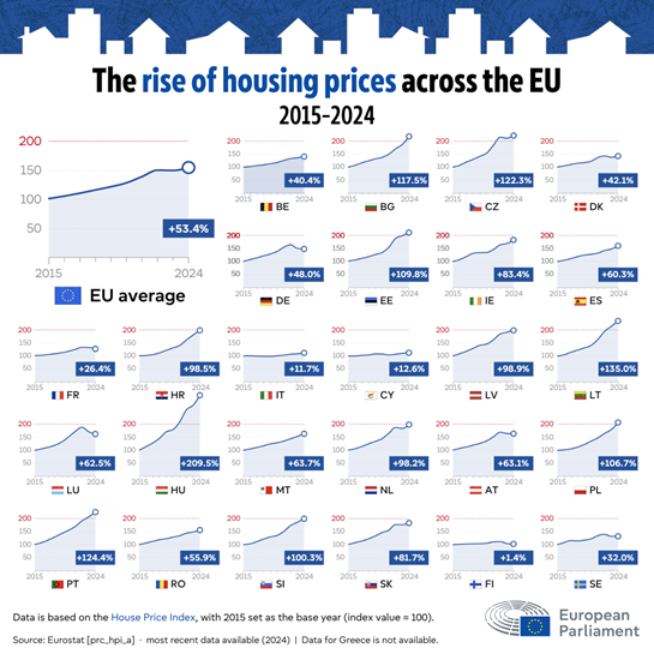
According to the July 2024 Eurobarometer survey, the main concerns motivating voters in the most recent European elections were rising prices and the cost-of-living situation. The housing crisis, reflected in an average 53% increase in house prices over the past decade, has taken an enormous toll on European society, hurting labour mobility, access to education and family formation. Overall, this crisis is hampering both the competitiveness of the EU economy and its social cohesion.
The greatest increases in house prices during the period between 2015 and 2024 were observed in Hungary (+209.5%), Lithuania (+135%) and Portugal (+124.4%). Renting in the EU has also become costlier. Between 2010 and the first quarter of 2025, rent prices rose by an average of 27.8 %. Rents went up in all EU countries except Greece (-11%). The biggest rises were in Estonia (+220%), Lithuania (+184%), Hungary (+124%) and Ireland (+115%). This is partially due to an increase in short-term rentals, which have taken houses and apartments out of the market.
Source: Eurostat
Certain areas feel the crisis particularly sharply. Europe’s cities and popular tourist destinations face the strongest pressures. At the same time, depopulating and rural areas including some outermost regions of the EU are facing declining prices and difficulties in accessing essential services and infrastructure.
At the same time, the share of social housing in total supply has shrunk since 2010, even as the number of vulnerable people, such as homeless people and new migrants, has increased. This contraction of affordable housing has ripple effects far beyond those traditionally classified as vulnerable: young people delay leaving the parental home and starting their families, students turn down places at top universities, and essential workers such as teachers and nurses refuse jobs in major cities because they are priced out of housing. In this context, the equation between opportunity and cost has tipped decisively out of balance.
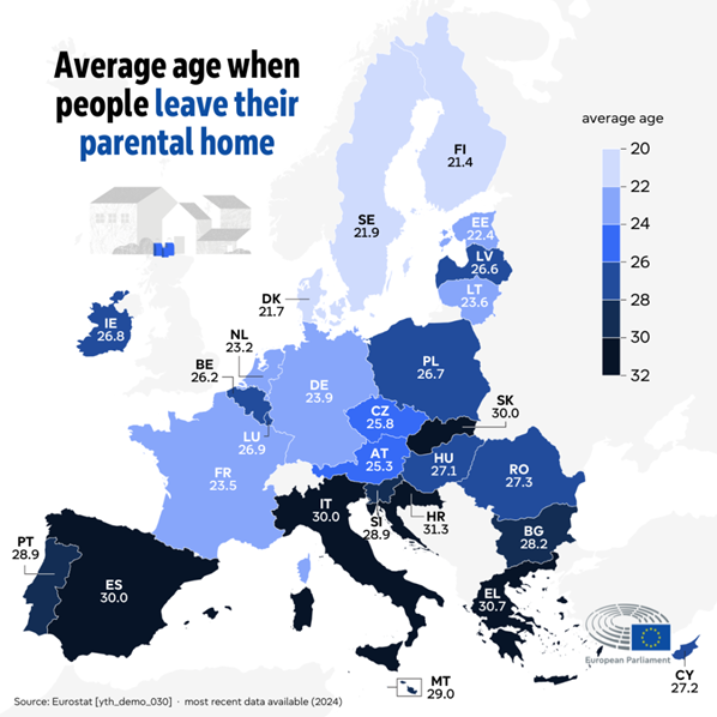
This imbalance is particularly visible among young people, for whom housing costs are the primary factor when deciding whether to move out of the family home. Across the EU, the average age of leaving the parental household reached 26.2 years in 2024, with stark disparities between member states—ranging from 21.4 years in Finland to 31.3 years in Croatia. Furthermore, in Southern and Eastern European countries, cultural norms also influence the timing of leaving the parental home, with young women often leaving earlier than young men. According to Eurostat, in 2022, the average age at which young women left the parental home in the EU was 25.4 years, compared with 27.3 years for young men. In these contexts, high rental prices disproportionately affect young women, limiting their independence and access to education, work, and social participation.
Source: Eurostat
The European Investment Bank identifies limited housing supply as one of the key drivers of Europe’s housing crisis. Approximately half of Europe’s housing stock was built before 1980, and a significant share requires renovation, particularly due to poor energy efficiency, with many buildings rated D or lower on the Energy Performance Certificate scale under the Energy Performance of Buildings Directive. The 2008 global financial crisis triggered a sharp decline in investment in new housing, a trend that was further exacerbated by the COVID-19 pandemic, which led to even slower residential construction. Since 2021, building permits for residential properties have fallen by more than 20%. Insufficient new housing to meet growing demand has consequently pushed prices upward. This pressure was further intensified by prolonged low interest rates, which stimulated demand, especially during COVID-19 lockdowns, and the expansion of teleworking, as households spent more time at home. In more recent years, housing inflation has been driven by persistent supply constraints and rising energy prices, partly linked to Russia’s invasion of Ukraine. Finally, the growth of short-term rental markets, through platforms such as Airbnb, has been widely criticised for exacerbating housing shortages, prompting several cities and municipalities to introduce restrictions on short-term rentals.
To tackle the Housing Crisis, the European Parliament set up a special committee to analyse the root causes and propose solutions for how the EU should address it. The committee’s initial one-year mandate was extended by six months until 30 July 2026, and it will conclude with a Parliamentary Own-Initiative Report that will feed into the development of the Commission’s policy response to the issue.
Further, addressing the European housing crisis is a priority in President von der Leyen’s Political Guidelines presented for the current Commission’s term 2024-2029. The commitment to make housing more affordable and sustainable was reiterated during the 2025 State of the Union address. Carrying on with this promise the Commission’s President appointed Dan Jørgensen as the first-ever EU commissioner for housing. He has been working towards the affordable housing objectives. First, in March 2025, the European Commission and the European Investment Bank announced plans for investments of around €10 billion over the following two years in affordable and sustainable housing.
Between 2 May and 4 June 2025, the European Commission opened a call for evidence in view of developing an affordable housing plan for the EU, which closed on 4 June 2025 and received contributions from 313 stakeholders and citizens. This was followed by a public consultation held from 11 July to 17 October 2025, aimed at gathering views from both the public and experts on potential policy solutions, and which collected over 13,000 responses. Recurring themes in submissions included faster permitting and brownfield repurposing; Energy Performance of Buildings Directive‑aligned deep renovations and distributed renewable energy inputs; clearer and more flexible State aid for affordable-housing Services of General Economic Interest; stronger crowding-in of investment; and proportionate rules to manage short-term rentals and vacant properties. In September 2025, the Parliament approved new rules for EU cohesion and social funding, allowing for such resources to be allocated to affordable and sustainable housing. MEPs also called on EU countries to “at least double” their funding for affordable housing in order to solve the EU’s housing crisis, which they described as severe.
The European Affordable Housing Plan was presented the 16th of December 2025 together with a revision of State aid rules on services of general interest to better support affordable housing, a European Strategy for Housing Construction, and a Communication and proposal for a Council recommendation on the New European Bauhaus. It will be complemented in 2026 by a Citizens Energy Package aimed at further lowering energy bills, delivering a just transition, eradicating energy poverty and empowering people and communities.
The European Affordable Housing Plan represents the first comprehensive EU-level strategy to address the deepening challenges of housing affordability, quality, and availability across the Union. Framed by the European Commission as not merely a housing issue but a social and competitiveness crisis, the Plan acknowledges that skyrocketing prices and rents are undermining labour mobility, family formation, and economic resilience.
Legally, the Plan takes the form of a Commission Communication rather than binding legislation such as a regulation or directive. Its primary objective is to coordinate national, regional, and local actions and to mobilise EU funding and policy tools where they can bring added value, while respecting that housing remains largely within the competence of Member States.
According to the Commission’s estimates, the EU needs more than two million new homes per year to meet current demand, which implies building roughly 650,000 additional units annually above the present construction rate. Bridging this gap would require approximately €150 billion in investment each year, highlighting both the scale of the challenge and the need for coordinated public and private finance.
The Plan is structured around four strategic pillars: 1) boosting housing supply 2) mobilising investment, 3) enabling immediate support and reforms and 4) protecting those most affected, with a total of ten key actions designed to increase housing availability, tackle administrative barriers, promote innovation, and support vulnerable groups:
Pillar I Boosting housing supply: seeks to address the persistent gap between housing demand and availability, especially in high-demand areas, by expanding social and affordable housing for low- and middle-income households. It targets structural constraints such as rising construction costs, stagnant productivity, labour shortages, limited capacity, and complex regulatory frameworks. Guided by the New European Bauhaus, the EU promotes a housing transformation that integrates affordability, sustainability, and quality, supported by digitalisation across planning, permitting, construction, and operation. Alongside new construction, the pillar emphasises better use of existing stock through renovation and repurposing, regulation of short-term rentals where they undermine long-term supply, and improved connectivity and services in rural areas to ease urban housing pressure.
To strengthen the construction sector (Action 1), the Commission supports innovative and industrialised building methods, skills development through initiatives such as Spain’s Strategic Project for Economic Recovery and Transformation, which delivers 15,000 affordable, energy-efficient homes annually. Labour shortages will be addressed through expanded training and apprenticeships, notably via the New European Bauhaus Academy, while cross-border provision of construction services will be facilitated through a European Strategy for Housing Construction and the forthcoming Construction Services Act (Q4 2026). In parallel, the Fair Labour Mobility Package (2026) will reinforce enforcement of labour rules for mobile workers, and the Commission will act against anti-competitive practices to ensure a competitive construction market capable of delivering affordable housing at scale.
Actions under Pillar I also focus on speeding up housing delivery and reducing long-term costs. To cut red tape (Action 2), the Commission has amended the sustainable finance framework (July 2025) and proposed streamlined environmental assessments and permitting for affordable and social housing (December 2025), with a Housing Simplification Package planned for 2027 to reduce administrative burdens, especially for SMEs, and promote digitalised permitting, while encouraging Member States to simplify planning and procurement rules. Housing costs are addressed through energy efficiency, electrification, and renovation, recognising energy bills as a key cost driver (Action 3). The Commission will accelerate renovations through Partnerships for Better Homes, one-stop-shop guidance, and support for National Building Renovation Plans, alongside an Energy Communities Action Plan (all by 2026). Sustainability is pursued holistically, including low-carbon materials, climate resilience, and inclusive, high-quality housing, in line with the New European Bauhaus, while Member States are encouraged to prioritise renovation and repurposing over demolition.
Pillar II Mobilizing Investment: This pillar addresses the long-term decline in housing investment across Member States, driven by constrained public budgets, rising land and construction costs, and tighter financing conditions. To close this investment gap, the EU is leveraging funding under the current Multiannual Financial Framework through Cohesion Policy Funds, InvestEU, NextGenerationEU, and other EU programmes, complemented by the Social Climate Fund for energy efficiency and renovation. Recent reforms—such as the mid-term review of Cohesion Policy—have increased flexibility and co-financing rates for affordable housing investments until 2029–2030, enabling Member States to reprogramme funds more easily. Looking ahead, the Commission plans to include social and affordable housing as a core objective in the next MFF (2028–2034), supported by instruments such as the EU Facility, Erasmus+ for student housing, and the European Competitiveness Fund, notably for building decarbonisation.
Actions under Pillar II focus on improving access to finance and simplifying public support mechanisms. Action 4 establishes a Pan-European Investment Platform for affordable and sustainable housing by Q3 2026, developed with the EIB Group and other financial institutions, to reduce fragmentation and increase visibility of financing opportunities. The Platform will support cooperation between public authorities and private investors, project aggregation, innovative financing models, and the sharing of best practices through a digital portal, expert group, and national hubs. Action 5 complements this by enabling faster and simpler public support through the revision of EU State aid rules, notably the SGEI Decision. The revision extends notification exemptions to affordable housing for low- and middle-income households without a compensation cap, while leaving social housing rules largely unchanged. This gives Member States greater flexibility to expand affordable housing schemes in line with national needs, under simplified administrative requirements and Commission guidance.
Pillar III Enabling immediate support while driving reforms: this pillar addresses acute housing affordability pressures in cities and tourist hotspots, where limited supply is intensified by the rapid growth of short-term rentals (STRs) and speculative investment, risking resident displacement and reduced access to jobs and education. It combines immediate, targeted interventions with structural reform. At EU level, support includes legislative and non-legislative measures such as a framework to identify housing-stressed areas and guidance on proportionate actions, including faster planning and permitting. Action 6 tackles STRs through the Regulation on Short-Term Rentals (EU) 2024/1028, effective May 2026, and a forthcoming initiative under a future Affordable Housing Act (Q4 2026), providing a coherent, data-driven basis for local authorities to act. Action 7 addresses speculative behaviour by increasing transparency on property ownership and transactions, supporting non-profit and limited-profit housing providers, facilitating investment via the Pan-European Investment Platform, and encouraging national taxation and planning measures to curb harmful speculation. Action 8 advances longer-term reforms through the European Semester and EU funding, helping Member States reduce administrative burdens, optimise land use, strengthen capacity, and expand social housing, drawing on models such as France’s Livret A system, Austria’s Vienna model, and emerging Czech and Polish schemes. Together, these measures aim to protect affordability, expand social and affordable housing, and strengthen long-term housing market resilience.
Pillar IV Supporting the most affected: this pillar recognises that the housing crisis disproportionately impacts vulnerable groups, including young people, students, apprentices, essential workers, low-income households, older people with limited pensions, single-parent families, migrants, LGBTIQ+ people, Roma and other marginalised communities, and persons with disabilities. High housing costs, limited availability, and poor-quality housing threaten independence, social participation, and access to education and employment, while increasing energy poverty. Ensuring affordable housing for essential workers is vital for resilient communities, and the EU’s revised State aid rules help Member States provide targeted housing for low- and middle-income households, contributing to broader goals such as ending homelessness by 2030.
Actions under Pillar IV focus on tailored solutions for vulnerable groups. Action 9 improves access to affordable housing for students, apprentices, and young people through investments via InvestEU, the Pan-European Investment Platform, and Cohesion Policy funding, complemented by innovative models such as co-living and intergenerational housing. Pilot schemes under Erasmus+ and guarantee mechanisms aim to reduce barriers like security deposits, with successful examples including Portugal’s EUR 375 million Affordable Student Housing programme, which provides over 18,000 beds. Action 10 addresses homelessness and supports vulnerable tenants through housing-led approaches such as Housing First, integrated with anti-poverty measures under the forthcoming EU Anti-Poverty Strategy (2026) and aligned with the European Pillar of Social Rights. The Commission will propose a Council recommendation, mobilise investment via the Pan-European Investment Platform, share best practices on tenant protection, and support energy-poor households through the Citizens Energy Package (2026). Member States are encouraged to expand social housing, improve accessibility for persons with disabilities, increase rental market transparency, and coordinate efforts with the next MFF and EU Facility, drawing on successful national examples like Finland’s Housing First programme.
EUROPEAN AFFORDABLE HOUSING PLAN: SUMMARY TABLE
| PILLAR | ACTION | DESCRIPTION |
| I Boosting housing supply | (1) Strengthening productivity and innovation in construction | Promote advanced construction materials and methods, such as offsite and modular construction, and digitalisation to increase resource efficiency and reduce building costs. |
| (2) Cutting red tape to accelerate housing supply | Reduce administrative burden, accelerate permitting and renovation, and improve cost efficiency through the new housing simplification package. | |
| (3) Combining affordability, sustainability and quality in housing | Use innovative materials and construction techniques to ensure housing is cost-effective, environmentally friendly, and high quality, aligned with the New European Bauhaus. | |
| II Mobilising investment | (4) Mobilising additional public and private investment | Create a Pan-European Investment Platform with the European Investment Bank, national/regional banks, and other financial institutions. |
| (5) Revise State aid rules enabling faster and simpler public support | Facilitate support for social and affordable housing projects without prior notification and authorisation by the Commission. | |
| III Enabling immediate support while driving reforms | (6) Addressing short-term rentals in areas under housing stress | Introduce a legislative initiative to mitigate the impact of short-term rentals on local housing affordability while balancing tourism benefits. |
| (7) Addressing speculation in the housing market | Identify speculative behaviours and promote transparency in the residential market. | |
| (8) Driving forward Member States’ structural reforms | Encourage reforms in spatial planning, social housing, and taxation to reduce complexity and enhance housing supply. | |
| IV Protecting the most affected | (9) Housing for young people | Mobilise investment for student housing, promote innovative housing models for young people, and assist mobile students from disadvantaged backgrounds. |
| (10) Preventing and addressing homelessness | Expand social housing and support people in vulnerable situations. |
The Commission will now focus on implementation of the plan. A new European Housing Alliance between Member States, cities, regions, EU institutions, housing providers and associations, social partners, industry and civil society will drive the implementation of the Plan. The Commission will present a progress report before the end of this mandate. Keeping the political momentum to solve this crisis is also key and the Commission has announced the first-ever EU Housing Summit in 2026.
Navigating the EU’s evolving affordable housing framework requires both regulatory expertise and strategic foresight. This is where Lykke Advice adds value. By monitoring the Affordable Housing Plan and forthcoming legislation related to it, interpreting policy developments, and identifying key funding opportunities, we support public and private stakeholders in making across the real estate, construction, rebar and building materials, construction technology, and energy sectors. Beyond compliance, Lykke Advice develops targeted public affairs strategies, engages with EU and national institutions, and builds cross-sector coalitions to help clients maximise investment, project delivery, and impact in affordable and sustainable housing across Europe.
